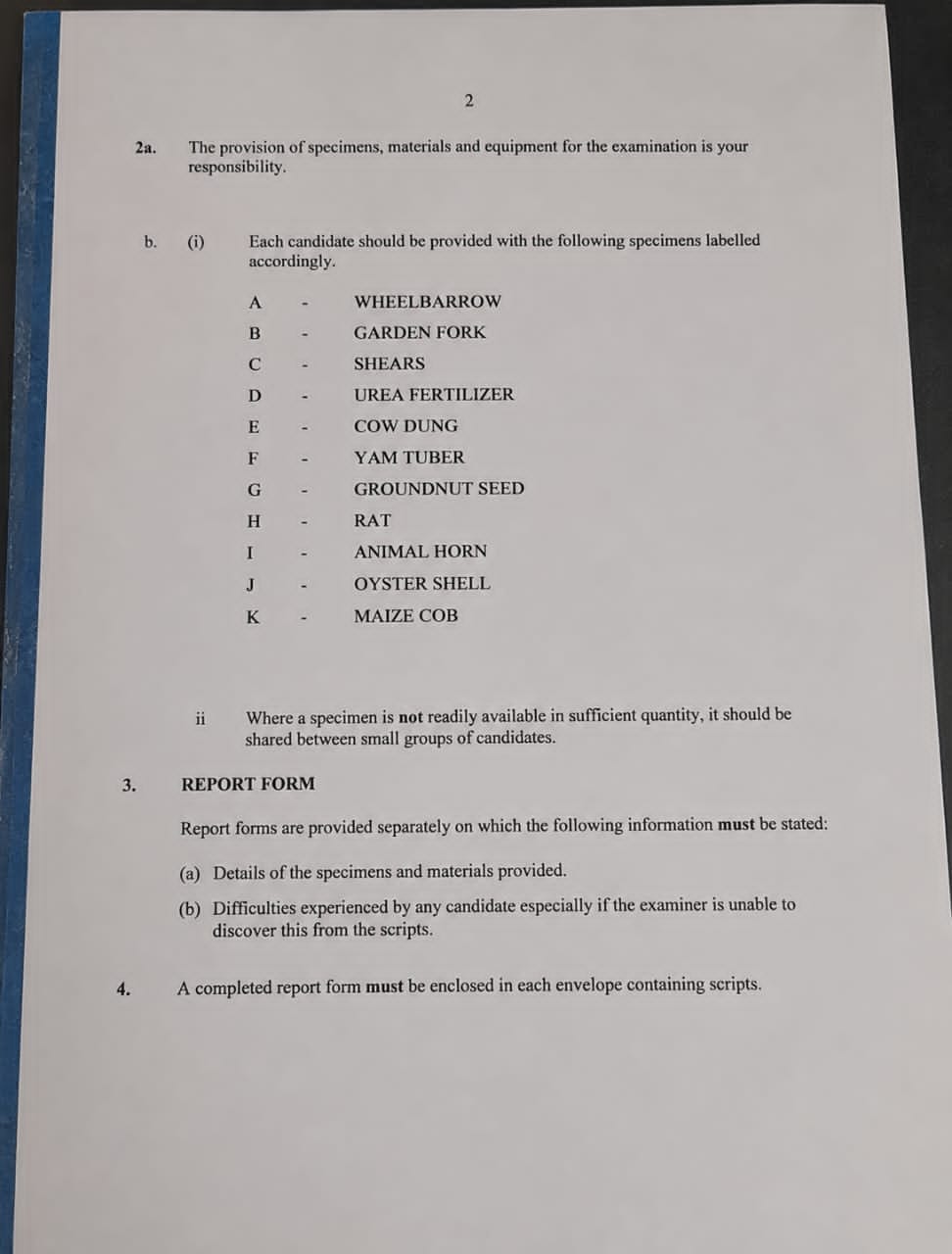
NECO Agricultural Science Practical Questions and Answers 2026: The National Examinations Council (NECO) Agricultural Science Practical Examination is an important component of the Senior School Certificate Examination (SSCE). It assesses candidates’ ability to identify agricultural specimens, understand farm tools and equipment, recognize livestock feeds and farm animals, and apply practical agricultural knowledge.
If you are sitting for the NECO Agricultural Science Practical Examination 2026, this page provides the complete practical questions, specimen identification, and detailed answers to help you revise effectively before and after the examination.
The practical questions and answers published here are based on the official NECO practical specimen list and practical examination paper. Every solution has been carefully prepared to help candidates understand the correct responses and improve their practical knowledge.
Whether you are aiming for an A1 or simply want to perform better in Agricultural Science, this guide will help you identify specimens correctly and answer practical questions with confidence.
This guide contains:
- Complete NECO Agricultural Science Practical Questions and Answers 2026
- Official Practical Specimen Identification
- Question-by-Question Solutions
- Practical Examination Instructions
- Frequently Asked Questions (FAQs)
- Examination Tips
Disclaimer: This article is intended for educational and revision purposes. Candidates should also study the NECO Agricultural Science syllabus, practical notebooks, classroom notes, and recommended textbooks for better understanding.
NECO Agricultural Science Practical Examination 2026
The NECO Agricultural Science Practical paper forms an essential part of the Agricultural Science examination. Candidates are expected to identify specimens, answer practical questions, state agricultural uses, explain farming practices, and demonstrate knowledge of crop and livestock production.
During the examination, candidates may be required to identify farm tools, fertilizers, animals, feeds, crop specimens, pests, diseases, and agricultural by-products.
Before entering the examination hall, candidates should:
- Read all practical instructions carefully.
- Study all prescribed specimens.
- Revise previous practical questions.
- Answer only the number of questions requested.
- Write clearly and neatly.
Proper preparation and familiarity with agricultural specimens can significantly improve candidates’ performance in the practical examination.
NECO Agricultural Science Practical Questions and Answers 2026
Question One (Specimens A, B and C) – Complete Answers
1(a) Identify Specimens A, B and C.
| Specimen | Answer |
|---|---|
| A | Wheelbarrow |
| B | Garden Fork |
| C | Shears |
1(b) State Three Physical Features of Specimen A.
- Has one wheel at the front.
- Has two handles for pushing.
- Has a deep metal tray for carrying loads.
- Has two supporting legs.
- Has a strong metal frame.
- The tray is concave in shape.
- Has rubber grips on the handles.
1(c) Mention Two Farm Operations Carried Out Using Specimen B.
- Turning and loosening the soil.
- Lifting and mixing manure or compost.
- Breaking soil clods.
- Aerating the soil.
- Uprooting root crops.
- Incorporating organic manure into the soil.
1(d) Enumerate Two General Maintenance Practices for Specimen B.
- Clean and dry it after use.
- Oil the metal parts before storage.
- Sharpen the prongs when blunt.
- Tighten loose handles and fittings.
- Store it in a dry place.
- Paint metal parts to prevent rust.
1(e) State Two Uses of Specimen C on the Farm.
- Trimming hedges and live fences.
- Pruning branches and shoots.
- Harvesting flowers.
- Cutting grasses and shrubs.
- Removing dead or diseased branches.
- Shaping ornamental plants.
1(f) Name One Simple Farm Tool That Can Be Used to Achieve the Same Purpose.
- A: Head pan
- B: Hoe
- C: Cutlass
More verified practical answers for Questions 2, 3 and 4 are provided in the next sections of this guide.
Question Two (Specimens D and E) – Complete Answers
2(a) Classify Specimens D and E Based on Their Sources.
| Specimen | Answer |
|---|---|
| D | Inorganic Fertilizer |
| E | Organic Fertilizer |
2(b) State Three Effects of Excess Application of Specimen D on a Farm.
- Scorches or burns crop leaves and roots.
- Causes excessive vegetative growth with poor yield.
- Increases soil acidity.
- Causes lodging of crops.
- Delays flowering and fruiting.
- Leads to nutrient imbalance in the soil.
- Pollutes nearby water bodies through leaching and runoff.
2(c) List Two Deficiency Symptoms of the Major Nutrient in Specimen D.
- Yellowing (chlorosis) of older leaves.
- Stunted or poor plant growth.
- Reduced tillering in cereal crops.
- Weak and slender stems.
- Premature leaf fall.
- Low crop yield.
2(d) Give One Reason for the Application of Specimen D in a Fish Pond.
- Promotes the growth of plankton which serves as fish food.
- Increases pond productivity.
- Enhances fish growth rate.
- Improves nutrient availability in pond water.
- Encourages the growth of microscopic aquatic organisms.
2(e) Enumerate Three Advantages of Using Specimen E Over Specimen D.
- Adds organic matter (humus) to the soil.
- Improves soil structure and water-holding capacity.
- Releases nutrients slowly over a longer period.
- Improves soil aeration.
- Encourages beneficial soil microorganisms.
- Reduces the risk of fertilizer burn.
- Is environmentally friendly and less polluting.
2(f) Highlight Two Precautions When Applying Specimen E.
- Use well-decomposed organic manure.
- Apply the correct quantity and mix it properly into the soil.
2(g) Mention Two Organic Materials That Serve the Same Purpose as Specimen E.
- Compost manure.
- Poultry droppings.
Question Three (Specimens F, G and H) – Complete Answers
3(a) State the Botanical Names of Specimens F and G.
| Specimen | Answer |
|---|---|
| F | Dioscorea rotundata |
| G | Arachis hypogaea |
3(b) List Three Cultural Practices Required for High Yield of the Plant That Produces Specimen F.
- Weeding.
- Staking.
- Mulching.
3(c) Mention Three Industrial Uses of Specimen G.
- Production of vegetable (groundnut) oil.
- Manufacture of margarine.
- Production of soap.
- Production of peanut butter.
- Manufacture of livestock feed (groundnut cake).
- Production of cosmetics.
- Used in the confectionery and snack industry.
3(d) State One Nature of Damage Done to Crops by Specimen H.
- Gnaws and eats seeds, fruits and tubers.
- Damages stems by gnawing them.
- Destroys stored grains and farm produce.
- Contaminates crops with urine and droppings.
- Digs burrows that damage plant roots.
3(e) Highlight Four Control Measures of Specimen H on the Farm.
- Use traps.
- Apply rodenticides (rat poison).
- Keep the farm and store clean.
- Encourage natural predators such as cats.
- Destroy rat burrows and hiding places.
- Store produce in rat-proof containers.
- Clear bushes and weeds around the farm.
- Seal holes and openings in storage facilities.
3(f) State One Crop Disease Caused by Virus in Specimens F and G.
- F: Yam Mosaic Disease.
- G: Groundnut Rosette Disease.
Question Four (Specimens I, J and K) – Complete Answers
4(a) Identify Specimens I, J and K.
| Specimen | Answer |
|---|---|
| I | Animal Horn |
| J | Oyster Shell |
| K | Maize Cob |
4(b) Enumerate Three Ways of Removing Specimen I from an Animal.
- Using a dehorning saw.
- Using a dehorning knife.
- Using a hot iron (disbudding).
- Using a scoop dehorner.
- Using a Barnes dehorner.
- Applying caustic dehorning paste.
- Using a wire saw.
4(c) State Three Reasons for Carrying Out the Operation in 4(b).
- To prevent injury to other animals.
- To prevent injury to the farmer or handler.
- To make handling and transportation easier.
- To reduce fighting among animals.
- To save space in animal housing.
- To prevent damage to farm equipment and facilities.
- To reduce bruises on carcasses and hides.
4(d) Mention Two Benefits of Including Specimens J and K in Livestock Feed.
Specimen J (Oyster Shell)
- Supplies calcium for strong bones and teeth.
- Improves eggshell formation in laying birds.
- Prevents calcium deficiency.
- Enhances bone development.
- Supports muscle and nerve functions.
- Improves growth and productivity.
Specimen K (Maize Cob)
- Provides fibre (roughage) for proper digestion.
- Promotes normal bowel movement and rumination.
- Prevents constipation.
- Improves rumen function.
- Serves as a source of bulk in livestock feed.
- Maintains digestive health.
4(e) Give One Disease Caused by Inadequate Supply of the Nutrients Contained in Specimens J and K.
- J: Rickets, Osteomalacia, Osteoporosis, Eggshell Thinning (Soft-shelled Eggs), or Milk Fever.
- K: Bloat, Constipation, Indigestion, Acidosis, or Ruminal Impaction.
Practical Examination Instructions
- Read every question carefully before answering.
- Identify each specimen correctly before attempting the questions.
- Answer only the number of points requested in each question.
- Write botanical names correctly and underline them where appropriate.
- Present your answers neatly and legibly.
- Avoid examination malpractice and follow all instructions given by the supervisors.
Conclusion
The NECO Agricultural Science Practical Examination 2026 is an important part of the Agricultural Science paper and contributes significantly to a candidate’s overall performance. Proper preparation, correct specimen identification, and a good understanding of practical agricultural concepts are essential for success.
Candidates should revise all the specimens, understand their agricultural importance, and practise answering practical questions within the required time. Paying attention to botanical names, farm tools, fertilizers, livestock feeds, pests, diseases, and animal management practices will greatly improve your performance.
Important Reminder: This article is provided as a revision guide to support your preparation. For the best results, combine it with the official NECO syllabus, your classroom notes, practical notebooks, recommended Agricultural Science textbooks, and previous years’ practical questions.
As the examination approaches, we will continue updating this page with additional verified practical questions, specimen explanations, and examination tips to help candidates prepare effectively.
Bookmark this page and visit regularly for the latest NECO Agricultural Science Practical updates.
We wish all NECO candidates success in the 2026 Agricultural Science Practical Examination.
If you found this guide helpful, kindly share it with your classmates, friends, and other NECO candidates preparing for the examination through WhatsApp, Facebook, Telegram, and other social media platforms.
Frequently Asked Questions (FAQs)
When is the NECO Agricultural Science Practical Examination 2026?
The NECO Agricultural Science Practical Examination is scheduled as part of the 2026 Senior School Certificate Examination (SSCE). Candidates should consult the official NECO timetable or their examination centre for the exact date and reporting time.
How Many Practical Questions Will I Answer?
Candidates are expected to answer all the practical questions provided in the examination paper and identify the required specimens correctly.
How Many Specimens Are Usually Provided?
The 2026 NECO Agricultural Science Practical Examination includes specimens covering farm animals, livestock feeds, fertilizers, forage crops, farm tools, animal by-products, and other agricultural materials. Candidates should study every specimen carefully before the examination.
Can I Score an A1 in NECO Agricultural Science Practical?
Yes. Candidates who understand specimen identification, revise practical questions, study the NECO syllabus, and practice previous practical examinations have an excellent chance of scoring an A1.
Will More Questions and Answers Be Updated?
Yes. This page will continue to be updated with additional verified practical questions, specimen explanations, revision materials, and examination tips whenever new information becomes available.
ALSO READ:
Write a story to illustrate the saying: There is light at the end of the tunnel.
NECO English Language Questions and Answers 2026
NECO Technical Drawing Questions and Answers 2026 (Essay & OBJ)