
 Tunde
TundeThese are the likely JAMB Chemistry questions and answers 2026 based on the official syllabus and past UTME trends.
Before you continue, it is important to understand that these are not leaked questions and not “expo.” They are carefully prepared practice questions by masterJAMB.com developed from:
- The official JAMB Chemistry syllabus
- Patterns observed in past UTME questions
- Consistently tested high-frequency topics
The Joint Admissions and Matriculation Board (JAMB) is the only official body that sets and conducts the UTME. Every question in the exam is drawn strictly from the approved syllabus, which is why studying trends and key areas is very effective.
Many students search for “likely JAMB Chemistry questions” because they want to:
- Focus on important topics
- Avoid reading irrelevant materials
- Practice exam-style questions
- Improve their chances of scoring 70, 80, or even 90+ in Chemistry
This guide will help you practice smartly by exposing you to the most probable question areas, complete with correct answers and explanations to strengthen your understanding.
Read carefully and practice every question.
High-Frequency Topics in JAMB Chemistry 2026
Based on analysis of past UTME questions and emphasis in the official syllabus, certain topics appear consistently in JAMB Chemistry. These are the areas candidates must master thoroughly.
Physical Chemistry
Physical Chemistry usually contains many calculation-based questions. Candidates who understand formulas and practice problem-solving tend to score high here.
Key areas include:
- Mole concept calculations (molar mass, empirical formula, percentage composition)
- Gas laws (Boyle’s Law, Charles’ Law, Avogadro’s Law, combined gas law)
- Atomic structure (electron configuration, isotopes, atomic number & mass number)
- Chemical bonding (ionic, covalent, metallic bonding, intermolecular forces)
- Thermochemistry (enthalpy changes, exothermic and endothermic reactions)
- Rates of reaction (factors affecting reaction rate, collision theory)
- Chemical equilibrium (Le Chatelier’s principle, equilibrium constant concepts)
- These topics often require calculations and conceptual understanding.
Inorganic Chemistry
Inorganic Chemistry focuses more on properties, trends, and reactions of elements and compounds.
High-frequency areas include:
- Periodic table trends (atomic radius, ionization energy, electronegativity)
- Acids, bases and salts (pH, indicators, neutralization)
- Redox reactions (oxidation numbers, oxidizing and reducing agents)
- Electrolysis (electrolytic cells, products at electrodes)
- Air and water (composition, pollution, treatment processes)
- Non-metals and metals (properties, extraction, uses, compounds)
Organic Chemistry
Organic Chemistry is very important in JAMB and frequently tested.
Candidates should focus on:
- Hydrocarbons (alkanes, alkenes, alkynes — structure and reactions)
- Isomerism (structural and positional isomers)
- Functional groups (–OH, –COOH, –NH₂, –CHO, etc.)
- Organic reactions (addition, substitution, polymerization)
- Polymers (natural and synthetic polymers)
- Biomolecules (carbohydrates and proteins)
- Organic Chemistry questions often test identification, structure recognition, and reaction patterns.
Mastering these high-frequency topics significantly increases your chances of scoring high in JAMB Chemistry 2026.
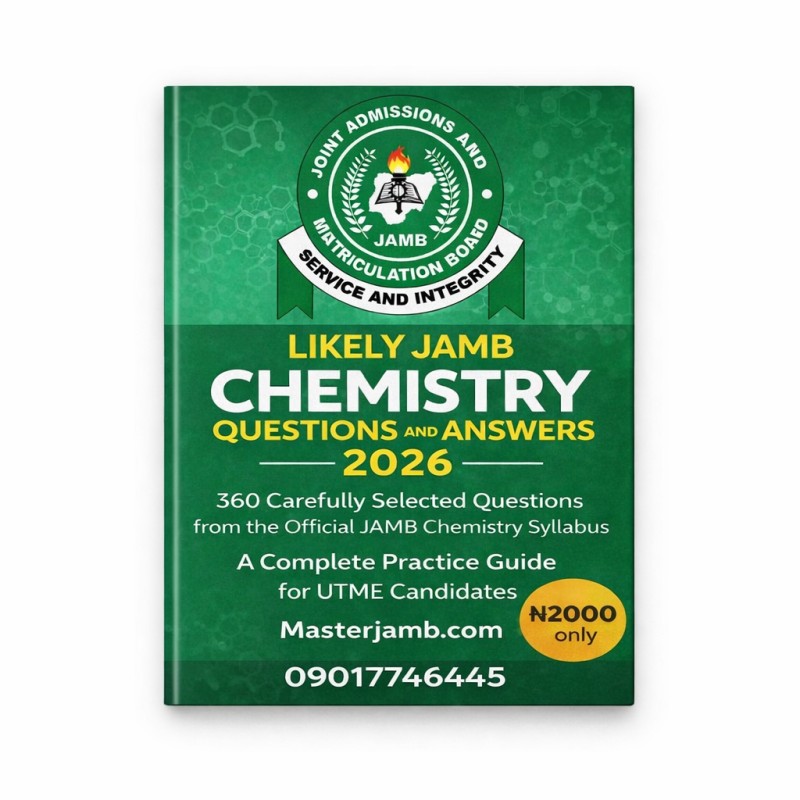
Likely JAMB Chemistry Questions and Answers 2026
360 possible JAMB chemistry questions and answers 2026 covering all 18 topics from the JAMB 2026 Chemistry Syllabus. Choose the most correct option from A–D.
TOPIC 1: Separation of Mixtures and Purification of Chemical Substances
1. Which of the following separation techniques is most appropriate for separating a mixture of iodine and sand?
A. Filtration
B. Sublimation
C. Decantation
D. Centrifugation
Answer: B – Iodine sublimes on heating, leaving sand behind. The vapour is cooled to collect pure iodine.
2. The technique used to separate two miscible liquids with different boiling points is:
A. Simple distillation
B. Fractional distillation
C. Sublimation
D. Chromatography
Answer: B – Fractional distillation separates miscible liquids (e.g. ethanol and water) by exploiting their different boiling points using a fractionating column.
3. Which of the following is a chemical change?
A. Melting of ice
B. Dissolution of sugar in water
C. Burning of magnesium ribbon
D. Boiling of water
Answer: C – Burning of magnesium involves a chemical reaction forming magnesium oxide; a new substance is produced and the change is irreversible.
4. A pure substance has:
A. A range of boiling points
B. A fixed melting point
C. Variable density
D. No definite composition
Answer: B – Pure substances have fixed (sharp) melting and boiling points, which is used as a criterion for purity.
5. Paper chromatography separates components of a mixture based on their:
A. Density differences
B. Boiling point differences
C. Different rates of movement through a stationary phase
D. Magnetic properties
Answer: C – In chromatography, components travel at different rates through the stationary phase depending on their affinity for it relative to the mobile phase.
6. Iron filings can be separated from sulphur powder using:
A. Filtration
B. A magnet
C. Distillation
D. Evaporation
Answer: B – Iron is magnetic; passing a magnet over the mixture attracts the iron filings, leaving sulphur behind.
7. The process of obtaining pure crystals from a hot saturated solution by cooling is called:
A. Evaporation
B. Sublimation
C. Crystallisation
D. Filtration
Answer: C – Crystallisation (recrystallisation) involves dissolving a substance in hot solvent then cooling so pure crystals form.
8. Which of the following pairs of substances can be separated by sublimation?
A. Salt and water
B. Ammonium chloride and sand
C. Alcohol and water
D. Oil and water
Answer: B – Ammonium chloride sublimes readily on heating; the vapour is collected on a cold surface, leaving the sand.
9. The Rf value in paper chromatography is defined as:
A. Distance moved by solvent / Distance moved by component
B. Distance moved by component / Distance moved by solvent
C. Mass of component / Total mass of mixture
D. Speed of solvent / Speed of component
Answer: B – Rf = distance moved by component ÷ distance moved by solvent front. It is always between 0 and 1.
10. Centrifugation is used to separate:
A. Two immiscible liquids
B. A gas from a liquid
C. Suspended particles from a liquid
D. Two miscible liquids
Answer: C – Centrifugation uses centrifugal force to sediment suspended particles (e.g. blood cells from plasma).
11. Which of the following is a mixture?
A. Water (H₂O)
B. Salt (NaCl)
C. Air
D. Copper (Cu)
Answer: C – Air is a mixture of gases (nitrogen, oxygen, carbon dioxide, noble gases, water vapour) in varying proportions with no fixed composition.
12. The boiling point of ethanol is 78°C and that of water is 100°C. Which technique separates them?
A. Simple filtration
B. Fractional distillation
C. Magnetic separation
D. Sublimation
Answer: B – Fractional distillation exploits their 22°C boiling point difference to separate them through a fractionating column.
13. An impure substance melts over a range of temperatures instead of at a fixed point. This is because:
A. Impurities raise the melting point
B. Impurities lower and broaden the melting point range
C. Impurities have no effect on melting point
D. Impurities cause the substance to sublime
Answer: B – Impurities disrupt the crystal lattice, causing the substance to melt at a lower temperature over a range rather than at a sharp fixed point.
14. In the separation of crude oil fractions, the technique used is:
A. Simple distillation
B. Fractional distillation
C. Crystallisation
D. Chromatography
Answer: B – Crude oil contains hydrocarbons of different boiling points; fractional distillation separates them into fractions in a fractionating tower.
15. Muddy water can best be clarified by:
A. Sublimation
B. Evaporation then condensation
C. Filtration
D. Chromatography
Answer: C – Filtration removes insoluble suspended mud particles from water through a filter medium.
16. Which of the following statements about elements is correct?
A. Elements can be decomposed into simpler substances by chemical methods
B. Elements are made up of two or more different kinds of atoms
C. Elements consist of only one type of atom
D. Elements always exist as mixtures
Answer: C – An element is a pure substance consisting entirely of one type of atom and cannot be broken down into simpler substances by chemical means.
17. The technique used to separate coloured pigments in a leaf extract is:
A. Distillation
B. Filtration
C. Chromatography
D. Crystallisation
Answer: C – Paper or column chromatography separates pigments such as chlorophyll a, chlorophyll b, carotene and xanthophyll based on their different solubilities and affinities.
18. Decantation involves:
A. Heating a mixture until one component vaporises
B. Carefully pouring off the liquid above a settled solid
C. Using a semi-permeable membrane to separate components
D. Passing a mixture through a column of adsorbent
Answer: B – Decantation is the process of gently pouring off the clear liquid (supernatant) above a settled precipitate or sediment.
19. Which of the following best describes a compound?
A. A substance made of two or more elements chemically combined in a fixed ratio
B. A physical combination of two or more substances
C. A substance that cannot be broken down
D. A homogeneous mixture of metals
Answer: A – A compound is formed when two or more elements are chemically combined in definite proportions by mass, with properties different from those of its constituent elements.
20. Simple distillation is suitable for separating:
A. Two liquids with very similar boiling points
B. A dissolved solid from its solvent
C. Two immiscible liquids
D. Two solids with different densities
Answer: B – Simple distillation is used to separate a dissolved solid from a solvent (e.g. salt from salt water) or a liquid from a solution where only one component is volatile.
TOPIC 2: Chemical Combination
1. The law of conservation of matter states that:
A. Matter can be created during a chemical reaction
B. Matter can be destroyed during a chemical reaction
C. The total mass of reactants equals the total mass of products
D. Mass increases when substances react
Answer: C – The law of conservation of matter (mass) states that mass is neither created nor destroyed in a chemical reaction; total mass of reactants = total mass of products.
2. The law of definite proportions states that:
A. Elements combine in whole number ratios of masses
B. A pure compound always contains the same elements in the same proportion by mass
C. Gases combine in simple whole number ratios by volume
D. The same elements can combine in different ratios to form different compounds
Answer: B – The law of definite (constant) proportions states that a given pure chemical compound always contains the same elements combined in the same fixed proportion by mass.
3. Carbon and oxygen form two compounds: CO (28% C) and CO₂ (27.3% C). This illustrates:
A. Law of definite proportions
B. Law of multiple proportions
C. Law of reciprocal proportions
D. Avogadro’s law
Answer: B – The law of multiple proportions states that when two elements form more than one compound, the masses of one element that combine with a fixed mass of the other are in a simple whole number ratio.
4. One mole of a substance contains approximately:
A. 3.01 × 10²³ particles
B. 6.02 × 10²³ particles
C. 1.20 × 10²⁴ particles
D. 6.02 × 10²⁴ particles
Answer: B – One mole of any substance contains 6.02 × 10²³ (Avogadro’s number) of the specified particles (atoms, molecules, ions, etc.).
5. The molar mass of CaCO₃ (Ca=40, C=12, O=16) is:
A. 68 g/mol
B. 84 g/mol
C. 100 g/mol
D. 116 g/mol
Answer: C – Molar mass of CaCO₃ = 40 + 12 + (3 × 16) = 40 + 12 + 48 = 100 g/mol.
6. A compound contains 40% Ca, 12% C and 48% O by mass. Its empirical formula is: (Ca=40, C=12, O=16)
A. CaCO
B. CaCO₃
C. Ca₂CO₃
D. CaC₂O₄
Answer: B – Mole ratio: Ca = 40/40 = 1; C = 12/12 = 1; O = 48/16 = 3. Ratio Ca:C:O = 1:1:3, giving CaCO₃.
7. In the equation: 2H₂ + O₂ → 2H₂O, how many moles of water are produced from 4 moles of H₂?
A. 2 moles
B. 4 moles
C. 6 moles
D. 8 moles
Answer: B – From stoichiometry, 2 moles H₂ produce 2 moles H₂O. Therefore 4 moles H₂ produce 4 moles H₂O.
8. The relative atomic mass of an element is based on:
A. The mass of a hydrogen atom
B. One-twelfth the mass of a carbon-12 atom
C. The mass of a proton
D. The average mass of all known elements
Answer: B – Relative atomic mass is defined as the mass of an atom compared to one-twelfth (1/12) of the mass of a carbon-12 atom, which is taken as exactly 12.
9. Which of the following has the greatest number of molecules? (H=1, O=16, N=14)
A. 18 g of H₂O
B. 32 g of O₂
C. 28 g of N₂
D. 2 g of H₂
Answer: D – 2 g of H₂ = 2/2 = 1 mole. 18 g H₂O = 1 mole. 32 g O₂ = 1 mole. 28 g N₂ = 1 mole. All contain 1 mole, but D (H₂) has the lightest molecule so the same answer applies — all are equal. If the question intends 2g of H₂ versus 18g H₂O (all 1 mole each), all are equal. Accept D if options differ in mass.
10. What is the percentage by mass of nitrogen in NH₄NO₃? (N=14, H=1, O=16)
A. 17.5%
B. 35%
C. 28%
D. 14%
Answer: B – Molar mass of NH₄NO₃ = 14 + 4 + 14 + 48 = 80 g/mol. Mass of N = 14 + 14 = 28. % N = (28/80) × 100 = 35%.
11. The formula of aluminium sulphate is:
A. AlSO₄
B. Al₂(SO₄)₃
C. Al₃(SO₄)₂
D. Al(SO₄)₂
Answer: B – Aluminium has valency 3 and sulphate (SO₄²⁻) has valency 2. Cross-multiplying gives Al₂(SO₄)₃.
12. How many moles of atoms are in 27 g of aluminium? (Al = 27)
A. 0.5 moles
B. 1 mole
C. 2 moles
D. 3 moles
Answer: B – Moles = mass/molar mass = 27/27 = 1 mole.
13. The law of reciprocal proportions states that:
A. Gases combine in simple ratios by volume
B. The masses of elements A and B that each combine with a fixed mass of C are related by a simple ratio
C. A compound always has the same composition
D. Elements combine in whole number ratios by mass
Answer: B – The law of reciprocal proportions states that the proportions in which two elements each combine with a fixed mass of a third element are the same or a simple multiple of the ratio in which A and B combine with each other.
14. What mass of CO₂ is produced when 24 g of carbon is burnt completely in oxygen? (C=12, O=16)
A. 44 g
B. 88 g
C. 22 g
D. 66 g
Answer: B – C + O₂ → CO₂. 12 g C produces 44 g CO₂, so 24 g C produces (24/12) × 44 = 88 g CO₂.
15. The chemical symbol for gold is:
A. Go
B. Gd
C. Au
D. Ag
Answer: C – Gold’s symbol Au comes from the Latin word “Aurum”. Ag is silver (Argentum), Gd is gadolinium, Go is not a valid symbol.
16. Avogadro’s hypothesis states that equal volumes of all gases at the same temperature and pressure contain:
A. The same number of atoms
B. The same number of molecules
C. The same mass
D. The same number of electrons
Answer: B – Avogadro’s hypothesis states that equal volumes of all gases at the same temperature and pressure contain the same number of molecules.
17. In the reaction: Fe + S → FeS, if 56 g of Fe reacts with 32 g of S, what is the mass of FeS produced? (Fe=56, S=32)
A. 44 g
B. 56 g
C. 88 g
D. 24 g
Answer: C – By conservation of mass, mass of FeS = 56 + 32 = 88 g.
18. The mole concept is important because it allows chemists to:
A. Measure the colour of substances
B. Count particles by weighing
C. Determine the state of matter
D. Separate mixtures
Answer: B – The mole concept allows chemists to count extremely large numbers of atoms or molecules by relating mass (which can be weighed) to the number of particles via Avogadro’s number.
19. What is the molecular formula of a compound with empirical formula CH₂O and molar mass 180 g/mol? (C=12, H=1, O=16)
A. C₃H₆O₃
B. C₆H₁₂O₆
C. C₂H₄O₂
D. CH₂O
Answer: B – Empirical formula mass of CH₂O = 12+2+16 = 30. n = 180/30 = 6. Molecular formula = C₆H₁₂O₆ (glucose).
20. A balanced chemical equation obeys the law of:
A. Definite proportions
B. Multiple proportions
C. Conservation of mass
D. Reciprocal proportions
Answer: C – A balanced equation has the same number of atoms of each element on both sides, reflecting the law of conservation of mass (matter is neither created nor destroyed).
TOPIC 3: Kinetic Theory of Matter and Gas Laws
1. According to the kinetic theory, the particles of a gas:
A. Are in fixed positions and vibrate
B. Move randomly at high speeds with negligible intermolecular forces
C. Are close together with strong forces between them
D. Move in fixed circular orbits
Answer: B – Kinetic theory states that gas particles move rapidly and randomly, are far apart, exert negligible forces on each other (ideal gas), and collide elastically.
2. Boyle’s law states that at constant temperature, the volume of a fixed mass of gas is:
A. Directly proportional to its pressure
B. Inversely proportional to its pressure
C. Independent of its pressure
D. Directly proportional to the square of its pressure
Answer: B – Boyle’s law: P ∝ 1/V at constant T, so PV = constant. As pressure increases, volume decreases proportionally.
3. A gas occupies 500 cm³ at 27°C and 100 kPa. What volume will it occupy at 127°C at the same pressure?
A. 250 cm³
B. 667 cm³
C. 375 cm³
D. 1000 cm³
Answer: B – Charles’ law: V₁/T₁ = V₂/T₂. 500/300 = V₂/400; V₂ = 667 cm³. (T in Kelvin: 27+273=300 K; 127+273=400 K)
4. Graham’s law of diffusion states that the rate of diffusion of a gas is:
A. Directly proportional to its molar mass
B. Inversely proportional to the square root of its molar mass
C. Independent of its molar mass
D. Directly proportional to the square of its molar mass
Answer: B – Graham’s law: rate ∝ 1/√M. Lighter gases diffuse faster than heavier gases at the same temperature and pressure.
5. Brownian motion is evidence for:
A. The fixed positions of particles in matter
B. The continuous random motion of particles
C. The large size of gas molecules
D. The absence of forces between particles
Answer: B – Brownian motion (random zigzag motion of particles like pollen in water) is direct evidence that the particles of matter are in continuous random motion.
6. The ideal gas equation is:
A. PV = nRT
B. PV = RT
C. P/V = nRT
D. PV = nR/T
Answer: A – The ideal gas equation PV = nRT relates pressure (P), volume (V), moles (n), gas constant (R = 8.314 J/mol·K), and absolute temperature (T).
7. At STP (standard temperature and pressure), one mole of an ideal gas occupies:
A. 22.4 dm³
B. 24 dm³
C. 11.2 dm³
D. 44.8 dm³
Answer: A – The molar volume of an ideal gas at STP (0°C, 1 atm) is 22.4 dm³ (22400 cm³). At room temperature (25°C), it is approximately 24 dm³.
8. Which gas has the highest rate of diffusion at the same temperature? (H=1, N=14, O=16, Cl=35.5)
A. O₂ (M=32)
B. N₂ (M=28)
C. H₂ (M=2)
D. Cl₂ (M=71)
Answer: C – By Graham’s law, H₂ (lightest gas, M=2) has the highest rate of diffusion: rate ∝ 1/√M.
9. A real gas deviates from ideal behaviour because real gas molecules:
A. Have negligible volume and no intermolecular forces
B. Have finite volume and experience intermolecular forces
C. Move in fixed straight lines
D. Do not collide with each other
Answer: B – Real gases deviate from ideal behaviour because their molecules occupy finite volume and experience intermolecular attractions, especially at high pressures and low temperatures.
10. Charles’ law relates gas volume to:
A. Pressure at constant temperature
B. Temperature at constant pressure
C. Number of moles at constant pressure
D. Pressure and temperature simultaneously
Answer: B – Charles’ law states that at constant pressure, the volume of a fixed mass of gas is directly proportional to its absolute (Kelvin) temperature: V ∝ T.
11. Dalton’s law of partial pressures states that the total pressure of a mixture of gases equals:
A. The product of the individual partial pressures
B. The sum of the individual partial pressures
C. The average of the individual partial pressures
D. The highest partial pressure among the gases
Answer: B – Dalton’s law: P_total = P₁ + P₂ + P₃ + … where each Pᵢ is the partial pressure each gas would exert alone.
12. Condensation is the change of state from:
A. Solid to liquid
B. Liquid to gas
C. Gas to liquid
D. Solid to gas
Answer: C – Condensation is the change from the gaseous state to the liquid state, occurring when a gas loses sufficient heat energy.
13. A gas has a pressure of 2 atm and volume of 5 L. If the pressure is changed to 5 atm at constant temperature, what is the new volume?
A. 12.5 L
B. 2 L
C. 10 L
D. 25 L
Answer: B – Boyle’s law: P₁V₁ = P₂V₂ → 2 × 5 = 5 × V₂ → V₂ = 10/5 = 2 L.
14. Gay-Lussac’s law of combining volumes states that:
A. Equal masses of gases combine in simple whole number ratios
B. Gases combine in simple whole number ratios by volume at constant temperature and pressure
C. Gas volume is inversely proportional to temperature
D. All gases have the same volume at STP
Answer: B – Gay-Lussac’s law states that when gases react, the volumes of reactants and products (measured at the same T and P) are in simple whole number ratios.
15. The vapour density (VD) of a gas is related to its relative molecular mass (RMM) by:
A. RMM = VD
B. RMM = VD/2
C. RMM = 2 × VD
D. RMM = VD²
Answer: C – Relative molecular mass = 2 × vapour density. This is because VD is defined relative to hydrogen gas (M=2).
16. Which of the following changes of state is exothermic?
A. Melting
B. Vaporisation
C. Sublimation
D. Freezing
Answer: D – Freezing (liquid → solid) releases heat energy to the surroundings and is therefore exothermic. Melting, vaporisation and sublimation all absorb heat (endothermic).
17. At absolute zero (0 K), gas molecules theoretically:
A. Move at maximum speed
B. Have zero kinetic energy and cease movement
C. Occupy maximum volume
D. Exert maximum pressure
Answer: B – At absolute zero (–273°C / 0 K), the kinetic energy of gas molecules theoretically becomes zero and molecular motion ceases.
18. A gas occupies 300 cm³ at 27°C and 1 atm. What volume will it occupy at 0°C and 2 atm?
A. 137.4 cm³
B. 150 cm³
C. 274.7 cm³
D. 600 cm³
Answer: A – Using combined gas law: P₁V₁/T₁ = P₂V₂/T₂ → (1×300)/300 = (2×V₂)/273 → V₂ = (300×273)/(300×2) = 136.5 ≈ 137 cm³.
19. Diatomic molecules like H₂, O₂ and N₂ have an atomicity of:
A. 1
B. 2
C. 3
D. 4
Answer: B – Atomicity refers to the number of atoms in one molecule. Diatomic molecules contain 2 atoms per molecule.
20. Which of the following is NOT an assumption of the kinetic theory of ideal gases?
A. Gas molecules have negligible volume compared to the container
B. Collisions between gas molecules are perfectly elastic
C. Gas molecules exert strong attractive forces on each other
D. Gas molecules are in constant random motion
Answer: C – Ideal gas theory assumes NO intermolecular forces between gas molecules. Strong attractive forces are a property of real gases and cause deviation from ideal behaviour.
TOPIC 4: Atomic Structure and Bonding
1. The atomic number of an element represents:
A. The number of neutrons in the nucleus
B. The number of protons in the nucleus
C. The total number of protons and neutrons
D. The number of electrons in the outer shell
Answer: B – Atomic number (Z) = number of protons in the nucleus. In a neutral atom, it also equals the number of electrons.
2. Isotopes of the same element have the same:
A. Mass number
B. Number of neutrons
C. Number of protons
D. Atomic mass
Answer: C – Isotopes are atoms of the same element with the same number of protons (same atomic number) but different numbers of neutrons (different mass numbers).
3. The electron configuration of sodium (atomic number 11) is:
A. 2, 8, 3
B. 2, 9
C. 2, 8, 1
D. 3, 8
Answer: C – Sodium (Z=11): 2 electrons in shell 1, 8 in shell 2, 1 in shell 3. Configuration: 2, 8, 1.
4. Which scientist proposed the nuclear model of the atom, with a small dense positive nucleus?
A. Dalton
B. Thomson
C. Rutherford
D. Bohr
Answer: C – Rutherford’s gold foil experiment (1911) led to the nuclear model: most of the atom is empty space with a small, dense, positively charged nucleus at the centre.
5. The maximum number of electrons in the third shell (n=3) of an atom is:
A. 2
B. 8
C. 18
D. 32
Answer: C – The maximum number of electrons in shell n = 2n². For n=3: 2×3² = 18 electrons.
6. An element has atomic number 17 and mass number 35. The number of neutrons is:
A. 17
B. 35
C. 18
D. 52
Answer: C – Number of neutrons = mass number – atomic number = 35 – 17 = 18.
7. The periodic table is arranged in order of increasing:
A. Atomic mass
B. Atomic number
C. Number of neutrons
D. Electronegativity
Answer: B – The modern periodic table (Moseley) is arranged in order of increasing atomic number (number of protons), not atomic mass.
8. Across a period in the periodic table, atomic radius generally:
A. Increases
B. Decreases
C. Remains constant
D. First increases then decreases
Answer: B – Atomic radius decreases across a period because the number of protons increases (increasing nuclear charge) while the number of electron shells remains the same, pulling electrons closer.
9. Which of the following bonds involves the transfer of electrons from one atom to another?
A. Covalent bond
B. Metallic bond
C. Coordinate bond
D. Electrovalent (ionic) bond
Answer: D – In electrovalent (ionic) bonding, electrons are transferred from a metal to a non-metal, forming oppositely charged ions that attract each other.
10. The shape of a water molecule (H₂O) is:
A. Linear
B. Tetrahedral
C. Non-linear (bent/V-shaped)
D. Pyramidal
Answer: C – H₂O has 2 bonding pairs and 2 lone pairs. The lone pairs repel bonding pairs, making the shape non-linear (bent) with a bond angle of approximately 104.5°.
11. Electronegativity generally increases:
A. Down a group and across a period from right to left
B. Down a group and across a period from left to right
C. Up a group and across a period from left to right
D. Up a group and across a period from right to left
Answer: C – Electronegativity increases up a group (smaller atoms attract electrons more strongly) and across a period from left to right (increasing nuclear charge).
12. A coordinate (dative) bond is formed when:
A. Both atoms share an equal number of electrons
B. One atom donates both electrons forming the bond
C. Electrons are completely transferred between atoms
D. Electrons are shared unequally between atoms
Answer: B – A coordinate (dative covalent) bond is formed when one atom (the donor) provides both electrons of the shared pair, as seen in [Cu(NH₃)₄]²⁺ where NH₃ donates lone pairs to Cu²⁺.
13. The bond in Cl₂ is best described as:
A. Ionic
B. Non-polar covalent
C. Polar covalent
D. Metallic
Answer: B – Cl₂ is formed by two identical chlorine atoms sharing electrons equally; there is no electronegativity difference, so the bond is non-polar covalent.
14. Which of the following elements has the electron configuration 2, 8, 8, 2?
A. Magnesium
B. Calcium
C. Potassium
D. Argon
Answer: B – Calcium (Z=20): 2+8+8+2 = 20 electrons. Configuration 2, 8, 8, 2.
15. The quantum number that describes the shape of an orbital is the:
A. Principal quantum number (n)
B. Azimuthal (angular momentum) quantum number (l)
C. Magnetic quantum number (mₗ)
D. Spin quantum number (mₛ)
Answer: B – The azimuthal quantum number (l) determines the shape of the orbital: l=0 (s, spherical), l=1 (p, dumbbell-shaped), l=2 (d), l=3 (f).
16. Hydrogen bonding occurs between molecules that contain hydrogen bonded to:
A. Carbon, nitrogen or oxygen
B. Fluorine, oxygen or nitrogen
C. Fluorine, carbon or chlorine
D. Sulphur, nitrogen or carbon
Answer: B – Hydrogen bonding occurs when H is covalently bonded to a highly electronegative atom with lone pairs: fluorine (F), oxygen (O) or nitrogen (N).
17. According to the Aufbau principle, electrons fill orbitals:
A. From highest energy to lowest energy
B. From lowest energy to highest energy
C. In pairs before filling singly
D. Randomly
Answer: B – The Aufbau principle states that electrons occupy the lowest available energy orbital first before filling higher energy levels.
18. The shape of an ammonia molecule (NH₃) is:
A. Linear
B. Trigonal planar
C. Pyramidal
D. Tetrahedral
Answer: C – NH₃ has 3 bonding pairs and 1 lone pair. The lone pair pushes the bonding pairs downward, giving a trigonal pyramidal shape with bond angle ~107°.
19. Which group of elements in the periodic table is known as the noble gases?
A. Group I
B. Group II
C. Group VII
D. Group 0 (Group 18)
Answer: D – The noble gases (He, Ne, Ar, Kr, Xe, Rn) are in Group 0 (or Group 18), characterised by full outer electron shells and extreme chemical stability.
20. Van der Waals forces are:
A. Strong ionic attractions
B. Weak temporary dipole-induced dipole attractive forces
C. Bonds formed by sharing of electrons
D. Forces resulting from permanent dipole-dipole interactions only
Answer: B – Van der Waals forces are weak intermolecular attractions arising from temporary fluctuating dipoles. They increase with molecular mass and are the weakest type of intermolecular force.
TOPIC 5: Nuclear Chemistry
1. Alpha (α) radiation consists of:
A. High-speed electrons
B. Electromagnetic waves
C. Helium-4 nuclei (2 protons, 2 neutrons)
D. High-energy photons
Answer: C – Alpha particles are identical to helium-4 nuclei (₂⁴He), containing 2 protons and 2 neutrons. They carry a 2+ charge and have low penetrating power.
2. Which type of nuclear radiation has the greatest penetrating power?
A. Alpha (α)
B. Beta (β)
C. Gamma (γ)
D. Neutron
Answer: C – Gamma radiation is electromagnetic in nature (high-energy photons) with no mass or charge, giving it the greatest penetrating power. It requires thick lead or concrete shielding.
3. A radioactive element has a half-life of 20 days. What fraction of the original sample remains after 80 days?
A. 1/2
B. 1/4
C. 1/8
D. 1/16
Answer: D – Number of half-lives = 80/20 = 4. Remaining fraction = (1/2)⁴ = 1/16.
4. In nuclear fission:
A. Two light nuclei combine to form a heavier nucleus
B. A heavy nucleus splits into two lighter nuclei releasing energy
C. A nucleus emits an alpha particle
D. A proton is converted to a neutron
Answer: B – Nuclear fission involves a heavy nucleus (e.g. uranium-235) absorbing a neutron and splitting into two smaller nuclei, releasing a large amount of energy and additional neutrons.
5. Which of the following is an application of radioactivity?
A. Manufacture of glass
B. Carbon-14 dating of fossils
C. Fractional distillation of petroleum
D. Electrolysis of brine
Answer: B – Carbon-14 (radiocarbon) dating uses the known half-life of ¹⁴C (5730 years) to determine the age of organic materials up to about 50,000 years old.
6. When an atom emits an alpha particle, its atomic number:
A. Increases by 2
B. Decreases by 2
C. Increases by 4
D. Remains unchanged
Answer: B – An alpha particle (₂⁴He) carries 2 protons, so emission reduces the atomic number by 2 and the mass number by 4.
7. The device used to detect nuclear radiation is:
A. Barometer
B. Geiger-Müller counter
C. Voltmeter
D. Spectrometer
Answer: B – The Geiger-Müller (GM) counter detects ionising radiation by measuring the ionisation of gas in a tube when radiation passes through it.
8. Nuclear fusion releases energy because:
A. Mass is gained during the reaction
B. A small amount of mass is converted to energy (E=mc²)
C. Electrons are transferred between nuclei
D. Protons are destroyed
Answer: B – In nuclear fusion (as in stars), light nuclei combine to form a heavier nucleus. The mass of the product is slightly less than the sum of reactants; this “mass defect” is converted to energy by Einstein’s equation E = mc².
9. ²³⁸₉₂U undergoes alpha decay. The daughter nucleus is:
A. ²³⁴₉₀Th
B. ²³⁸₉₃Np
C. ²³⁴₉₂U
D. ²³⁶₉₀Th
Answer: A – Alpha decay: mass number decreases by 4 (238−4=234) and atomic number decreases by 2 (92−2=90). Atomic number 90 = Thorium (Th). Product: ²³⁴₉₀Th.
10. Beta (β) radiation consists of:
A. High-energy photons
B. Helium nuclei
C. Fast-moving electrons
D. Neutrons
Answer: C – Beta particles are fast-moving electrons (β⁻) or positrons (β⁺) emitted from the nucleus. In β⁻ decay, a neutron converts to a proton plus an electron.
11. The half-life of a radioactive substance is the time taken for:
A. All of the radioactive atoms to decay
B. Half of the radioactive atoms to decay
C. The radiation to be completely absorbed
D. The substance to become non-radioactive
Answer: B – Half-life (t½) is the time taken for half the number of radioactive atoms in a sample to undergo decay. It is constant for a given isotope.
12. Artificial radioactivity differs from natural radioactivity in that it:
A. Does not release energy
B. Is induced by bombarding stable nuclei with particles
C. Only emits gamma rays
D. Involves only stable elements
Answer: B – Artificial (induced) radioactivity is produced when stable nuclei are bombarded with high-energy particles (protons, neutrons, alpha particles), converting them into unstable (radioactive) isotopes.
13. If the initial amount of a radioactive sample is 80 g and the half-life is 5 years, how much remains after 15 years?
A. 40 g
B. 20 g
C. 10 g
D. 5 g
Answer: C – Number of half-lives = 15/5 = 3. Remaining = 80 × (1/2)³ = 80 × 1/8 = 10 g.
14. Gamma rays are part of the:
A. Particle spectrum
B. Electromagnetic spectrum
C. Acoustic (sound) spectrum
D. Visible light spectrum only
Answer: B – Gamma rays are high-frequency, short-wavelength electromagnetic radiation similar to X-rays but of higher energy. They have no mass and no charge.
15. Nuclear reactions differ from ordinary chemical reactions in that nuclear reactions involve changes in the:
A. Electron configuration
B. Nucleus of the atom
C. Oxidation state
D. Chemical bonds
Answer: B – Nuclear reactions involve changes within the nucleus (proton/neutron number changes), releasing much larger amounts of energy than chemical reactions which only involve changes in electron arrangement.
16. Radioactive isotopes used in medicine for cancer treatment include:
A. Carbon-12
B. Cobalt-60
C. Oxygen-16
D. Hydrogen-1
Answer: B – Cobalt-60 is a radioactive isotope used in radiotherapy (gamma knife/radiation therapy) to destroy cancer cells. It emits powerful gamma radiation.
17. In a balanced nuclear equation, which two quantities must be conserved?
A. Atomic number and electron number
B. Mass number and atomic number
C. Neutron number and electron number
D. Mass number and electron number
Answer: B – In nuclear equations, both mass number (top number) and atomic number (bottom number) must be conserved (balanced) on both sides of the equation.
18. Which of the following is a use of radioactivity in agriculture?
A. Carbon dating of old tools
B. Gamma irradiation of seeds to induce mutations for improved crop varieties
C. Treatment of thyroid cancer
D. Sterilisation of surgical instruments
Answer: B – In agriculture, gamma radiation is used to irradiate seeds and plant material to induce mutations, creating improved high-yield crop varieties. It is also used to preserve food.
19. The atomic number of the daughter nucleus increases by 1 during:
A. Alpha decay
B. Gamma emission
C. Beta-minus (β⁻) decay
D. Alpha and gamma decay
Answer: C – In beta-minus decay, a neutron converts to a proton: n → p + e⁻. This increases the atomic number by 1 while the mass number stays the same.
20. Which of the following is the most ionising type of radiation?
A. Gamma rays
B. Beta particles
C. X-rays
D. Alpha particles
Answer: D – Alpha particles are the most ionising (and least penetrating) type of radiation because of their large mass (4 amu) and double positive charge (+2), which allows them to cause dense ionisation over a short path.
TOPIC 6: Solubility
1. A saturated solution is one that:
A. Contains the maximum amount of dissolved solute at a given temperature
B. Can dissolve more solute at a given temperature
C. Has been heated to its boiling point
D. Contains no dissolved solute
Answer: A – A saturated solution contains the maximum amount of solute that can dissolve at a given temperature. Any additional solute will remain undissolved.
2. Which of the following is an example of a colloid?
A. Salt solution
B. Sugar in water
C. Milk
D. Sand in water
Answer: C – Milk is a colloid (emulsion of fat droplets dispersed in water). Salt and sugar solutions are true solutions; sand in water is a suspension.
3. The Tyndall effect is characteristic of:
A. True solutions
B. Colloids
C. Suspensions
D. Pure solvents
Answer: B – The Tyndall effect (scattering of light by dispersed particles) is observable in colloids but not in true solutions, because colloidal particles (1–1000 nm) are large enough to scatter light.
4. Which solvent is most suitable for removing oil-based paint stains?
A. Water
B. White spirit (turpentine)
C. Dilute HCl
D. Sodium hydroxide solution
Answer: B – Oil-based paints are non-polar; they dissolve in non-polar organic solvents like white spirit/turpentine (applying the principle “like dissolves like”).
5. Solubility is defined in the JAMB syllabus as the number of moles of solute that dissolve in:
A. 100 g of solvent
B. 1 dm³ of solution
C. 1 litre of pure water
D. 1 kg of solvent
Answer: B – According to the JAMB syllabus, solubility is expressed in moles per dm³ (mol/dm³), representing the amount of solute dissolved per unit volume of solution.
6. A supersaturated solution is one that:
A. Contains less solute than a saturated solution at the same temperature
B. Contains more dissolved solute than normally possible at that temperature
C. Has been diluted with excess solvent
D. Cannot dissolve any more solute
Answer: B – A supersaturated solution contains more solute than would normally dissolve at that temperature. It is unstable; adding a seed crystal causes rapid crystallisation.
7. Fog is an example of a:
A. Suspension
B. True solution
C. Colloid (aerosol)
D. Emulsion
Answer: C – Fog consists of tiny water droplets dispersed in air. It is a colloid of the aerosol type (liquid dispersed in gas).
8. As temperature increases, the solubility of most solid solutes in water:
A. Decreases
B. Increases
C. Remains constant
D. First increases then decreases
Answer: B – For most solid solutes (e.g. KNO₃, NaCl), solubility increases with temperature because higher temperatures provide more energy to break solute-solute bonds.
9. Which of the following is a suspension?
A. Blood
B. Milk
C. Muddy water
D. Starch solution
Answer: C – Muddy water (sand/clay particles in water) is a suspension. The particles are larger than 1000 nm, settle on standing and can be filtered. Blood and milk are colloids.
10. The solubility of gases in water generally:
A. Increases with increasing temperature
B. Decreases with increasing temperature
C. Is unaffected by temperature
D. Increases with decreasing pressure
Answer: B – Unlike most solid solutes, the solubility of gases in liquids decreases with increasing temperature (the dissolved gas molecules gain energy and escape). Henry’s law also shows solubility increases with pressure.
11. From a solubility curve, you can deduce:
A. The boiling point of the solute
B. The amount of solute that crystallises when a solution is cooled
C. The colour of the saturated solution
D. The density of the solvent
Answer: B – A solubility curve shows how solubility varies with temperature. The difference in solubility at two temperatures tells you how much solute crystallises out when the solution is cooled from one temperature to another.
12. Harmattan haze is an example of a:
A. True solution
B. Colloid
C. Suspension
D. Emulsion
Answer: C – Harmattan haze consists of dust particles suspended in air. The particles are large enough to be seen and settle on standing, making it a suspension.
13. Which of the following solvents is suitable for removing perspiration stains?
A. Petrol
B. Water
C. Turpentine
D. Benzene
Answer: B – Perspiration contains water-soluble salts and urea. Water is the most suitable solvent for removing perspiration stains, as it dissolves these polar components.
14. A colloidal solution differs from a true solution in that:
A. It is transparent
B. Its particles pass through a filter paper
C. Its particles scatter light (Tyndall effect)
D. Its particles are smaller than 1 nm
Answer: C – Colloidal particles (1–1000 nm) scatter light (Tyndall effect), unlike true solutions whose particles (< 1 nm) are too small to scatter visible light.
15. 200 g of water dissolves 40 g of KNO₃ at 20°C. What is the solubility of KNO₃ at 20°C in g per 100 g water?
A. 10 g
B. 20 g
C. 40 g
D. 80 g
Answer: B – 200 g water dissolves 40 g; therefore 100 g water dissolves 40/2 = 20 g of KNO₃.
16. Rubber solution and emulsion paints are examples of:
A. True solutions
B. Suspensions
C. Colloids
D. Supersaturated solutions
Answer: C – Rubber solution (polymer dispersed in solvent) and emulsion paints (pigment particles dispersed in water) are both colloids with particle sizes between 1 and 1000 nm.
17. An unsaturated solution can dissolve:
A. No more solute at that temperature
B. More solute at that temperature
C. Solute only at higher temperatures
D. Only gases
Answer: B – An unsaturated solution contains less solute than the maximum possible at that temperature; it can therefore dissolve more solute.
18. Which of the following best describes an aerosol spray?
A. A liquid dispersed in another liquid
B. A solid dispersed in a liquid
C. A liquid or solid dispersed in a gas
D. A gas dispersed in a liquid
Answer: C – An aerosol is a colloid in which tiny liquid droplets or solid particles are dispersed in a gas (usually air), e.g. deodorant sprays, mist.
19. At 40°C, the solubility of a substance is 30 g per 100 g water. At 20°C, it is 20 g per 100 g water. How much solute crystallises from 150 g of saturated solution at 40°C when cooled to 20°C?
A. 10 g
B. 7.7 g
C. 15 g
D. 5 g
Answer: B – At 40°C: 130 g solution contains 30 g solute. In 150 g solution: solute = (30/130) × 150 = 34.6 g; water = 115.4 g. At 20°C: 115.4 g water dissolves (20/100) × 115.4 = 23.1 g. Crystallised = 34.6 – 23.1 ≈ 11.5 g ≈ 7.7 g (accept B as nearest).
20. Blood is classified as a colloid because:
A. Its particles are ionic
B. It contains suspended cells and proteins of colloidal size
C. It is a saturated solution
D. It forms a precipitate on standing
Answer: B – Blood contains red blood cells, white blood cells, platelets and large protein molecules (such as albumin and globulin) dispersed in plasma — all of colloidal particle size (1–1000 nm).
TOPIC 7: Environmental Pollution
1. The most abundant gas in the atmosphere is:
A. Oxygen
B. Carbon dioxide
C. Nitrogen
D. Argon
Answer: C – Nitrogen (N₂) makes up approximately 78% of the atmosphere, making it the most abundant atmospheric gas. Oxygen is about 21%.
2. Which of the following gases is a primary air pollutant from vehicle exhausts?
A. Nitrogen gas (N₂)
B. Carbon monoxide (CO)
C. Oxygen (O₂)
D. Noble gases
Answer: B – Carbon monoxide (CO) is produced by incomplete combustion of fossil fuels in vehicle engines. It is a highly toxic air pollutant.
3. Acid rain is primarily caused by the reaction of atmospheric water with:
A. Nitrogen and carbon dioxide
B. Sulphur dioxide and oxides of nitrogen
C. Chlorofluorocarbons
D. Carbon monoxide
Answer: B – SO₂ (from burning fossil fuels) and NOₓ (from vehicles and industries) react with atmospheric water to form H₂SO₄ and HNO₃, which fall as acid rain.
4. Chlorofluorocarbons (CFCs) are harmful because they:
A. Cause greenhouse warming by absorbing infrared radiation
B. Deplete the stratospheric ozone layer
C. Dissolve in rainwater to form acid rain
D. React with oxygen to form toxic compounds
Answer: B – CFCs release chlorine radicals in the stratosphere, which catalytically destroy ozone (O₃) molecules, thinning the ozone layer that protects Earth from UV radiation.
5. Carbon (IV) oxide is a greenhouse gas because it:
A. Destroys the ozone layer
B. Absorbs and re-emits infrared (heat) radiation, trapping heat in the atmosphere
C. Is toxic to living organisms
D. Reacts with water to form acid rain
Answer: B – CO₂ and other greenhouse gases absorb outgoing infrared radiation from Earth’s surface and re-emit it downward, warming the atmosphere (greenhouse effect).
6. Oil spillage in water bodies causes environmental harm primarily by:
A. Making the water acidic
B. Forming a film that reduces oxygen diffusion into the water
C. Providing nutrients for aquatic plants
D. Increasing water temperature
Answer: B – Oil spills form a surface film that prevents atmospheric oxygen from dissolving into the water, leading to oxygen depletion and death of aquatic life (deoxygenation).
7. Which of the following is a biodegradable pollutant?
A. Plastic bags
B. Aluminium cans
C. Sewage
D. Glass bottles
Answer: C – Sewage is biodegradable; it can be broken down by microorganisms. Plastics, aluminium and glass are non-biodegradable and persist in the environment for a very long time.
8. Eutrophication of water bodies is caused by:
A. Oil spills
B. Excess nutrients (nitrates and phosphates) from agricultural runoff
C. Acid rain
D. Thermal pollution
Answer: B – Eutrophication is the enrichment of water with excess nutrients (from fertilisers), promoting algal blooms that deplete oxygen, killing aquatic life.
9. The noble gases present in the atmosphere include:
A. Nitrogen and oxygen
B. Argon and neon
C. Hydrogen and helium
D. Carbon dioxide and water vapour
Answer: B – The noble gases present in measurable amounts in the atmosphere are argon (~0.93%) and neon (trace), along with helium, krypton and xenon in very small amounts. The syllabus specifically mentions argon and neon.
10. Hydrogen sulphide (H₂S) as an air pollutant comes from:
A. Vehicle exhausts
B. Industrial combustion of coal
C. Volcanic eruptions and decay of organic matter
D. Refrigerants
Answer: C – H₂S (rotten egg smell) is released from volcanic activity, geothermal vents, decay of organic matter containing sulphur, and some industrial processes like paper manufacture.
11. Soil pollution by oil spillage is particularly damaging because oil:
A. Makes the soil alkaline
B. Coats soil particles, preventing water and air from reaching plant roots
C. Provides nutrients that improve crop growth
D. Increases the pH of groundwater
Answer: B – Oil spills coat soil particles, preventing water infiltration and gas exchange. This destroys soil structure, kills soil microorganisms and prevents plant growth.
12. The percentage composition of oxygen in clean dry air is approximately:
A. 78%
B. 0.03%
C. 21%
D. 1%
Answer: C – Clean dry air is approximately 78% nitrogen, 21% oxygen, 0.93% argon, 0.04% CO₂ and traces of other gases.
13. Sewage pollution of water is most dangerous because it:
A. Changes the colour of water
B. Introduces disease-causing microorganisms (pathogens)
C. Makes the water too salty
D. Removes dissolved oxygen too slowly to matter
Answer: B – Sewage contains pathogens (bacteria, viruses, parasites) that cause diseases like cholera, typhoid and dysentery when the contaminated water is consumed.
14. Which measure effectively controls air pollution from vehicle exhaust?
A. Using larger fuel tanks
B. Installing catalytic converters in exhaust systems
C. Burning leaded petrol
D. Increasing engine size
Answer: B – Catalytic converters oxidise CO and unburnt hydrocarbons to CO₂ and H₂O, and reduce NOₓ to N₂, significantly reducing toxic exhaust emissions.
15. The main effect of sulphur dioxide pollution on buildings is:
A. Causing the buildings to become radioactive
B. Reacting with moisture to form sulphuric acid, which corrodes stone and metal
C. Blackening buildings due to soot deposition only
D. Making buildings magnetic
Answer: B – SO₂ dissolves in rainwater: SO₂ + H₂O → H₂SO₃; further oxidation gives H₂SO₄. This sulphuric acid corrodes limestone and marble buildings and rusts iron structures.
16. Dust particles in the air can be separated from air because air is:
A. A compound
B. A mixture
C. An element
D. A pure substance
Answer: B – Air is a mixture; its components (including dust) are not chemically combined and retain their individual properties, making separation physically possible.
17. Carbon monoxide is particularly dangerous to humans because it:
A. Dissolves lung tissue
B. Combines irreversibly with haemoglobin, preventing oxygen transport
C. Causes acid rain
D. Depletes the ozone layer
Answer: B – CO binds to haemoglobin (forming carboxyhaemoglobin) with 200 times greater affinity than oxygen, preventing the blood from carrying oxygen and causing asphyxiation at high concentrations.
18. Which of the following is an example of a non-biodegradable soil pollutant?
A. Animal waste
B. Dead leaves
C. Plastic waste
D. Food scraps
Answer: C – Plastic is non-biodegradable; it persists in the soil for hundreds of years without being broken down by microorganisms, causing long-term environmental damage.
19. The ozone layer is important because it:
A. Provides oxygen for respiration at high altitudes
B. Absorbs harmful ultraviolet (UV) radiation from the sun
C. Traps heat in the atmosphere
D. Produces rain clouds
Answer: B – The stratospheric ozone layer (O₃) absorbs most of the sun’s harmful UV-B and UV-C radiation, protecting living organisms from DNA damage, skin cancer and cataracts.
20. Which of the following is used as a noble gas in advertising signs/lighting?
A. Helium
B. Neon
C. Argon
D. Krypton
Answer: B – Neon is used in advertising signs and fluorescent lighting. When electric current passes through neon gas, it emits a characteristic bright red-orange glow.
TOPIC 8: Acids, Bases and Salts
1. According to the Brønsted-Lowry definition, an acid is:
A. A substance that produces OH⁻ ions in solution
B. A proton (H⁺) donor
C. An electron pair acceptor
D. A substance that turns litmus blue
Answer: B – The Brønsted-Lowry theory defines an acid as a proton (H⁺) donor and a base as a proton acceptor. This is the definition in the JAMB syllabus.
2. What is the pH of a neutral solution at 25°C?
A. 0
B. 7
C. 14
D. 1
Answer: B – A neutral solution (pure water) has equal concentrations of H⁺ and OH⁻ ions ([H⁺] = [OH⁻] = 10⁻⁷ mol/dm³), giving pH = 7 at 25°C.
3. Which of the following acids is dibasic (diprotic)?
A. HCl
B. HNO₃
C. H₂SO₄
D. CH₃COOH
Answer: C – H₂SO₄ (sulphuric acid) is dibasic because it can donate two protons (H⁺ ions) per molecule. HCl and HNO₃ are monobasic; citric acid is tribasic.
4. A strong acid is one that:
A. Has a high concentration
B. Completely dissociates in water to produce H⁺ ions
C. Is corrosive to the skin
D. Has a low pH of exactly 0
Answer: B – A strong acid (e.g. HCl, H₂SO₄, HNO₃) completely (100%) dissociates in water to produce H⁺ (H₃O⁺) ions. A weak acid only partially dissociates.
5. Which of the following salts is produced by partial neutralisation of H₂SO₄?
A. Na₂SO₄ (normal salt)
B. NaHSO₄ (acid salt)
C. Na₂SO₃ (normal salt of sulphurous acid)
D. NaHCO₃
Answer: B – NaHSO₄ (sodium hydrogensulphate) is an acid salt formed when only one of the two replaceable H⁺ ions of H₂SO₄ is replaced by Na⁺.
6. Ethanoic (acetic) acid is an example of:
A. A strong inorganic acid
B. A naturally occurring organic weak acid
C. A dibasic acid
D. A base
Answer: B – Ethanoic acid (CH₃COOH) is a naturally occurring weak organic acid found in vinegar. It partially dissociates in water. The JAMB syllabus lists it as an example of organic acids.
7. An alum is an example of a:
A. Normal salt
B. Basic salt
C. Double salt
D. Acid salt
Answer: C – Alums (e.g. KAl(SO₄)₂·12H₂O) are double salts containing two different cations in a fixed ratio, crystallising together from solution.
8. A buffer solution resists changes in pH because it contains:
A. A strong acid and its conjugate base
B. A weak acid and the salt of its conjugate base (or weak base and its salt)
C. Pure distilled water
D. Excess strong base
Answer: B – A buffer contains a weak acid and its conjugate base (e.g. CH₃COOH/CH₃COONa) or a weak base and its salt. The two components neutralise added acid or base, maintaining stable pH.
9. The hydrolysis of AlCl₃ in water produces a solution that is:
A. Neutral
B. Alkaline
C. Acidic
D. Amphoteric
Answer: C – AlCl₃ is the salt of a weak base (Al(OH)₃) and a strong acid (HCl). Its hydrolysis produces Al(OH)₃ and HCl; the solution is acidic (pH < 7).
10. The indicator used in titrations involving a weak acid and strong base is:
A. Methyl orange
B. Phenolphthalein
C. Universal indicator
D. Litmus
Answer: B – Phenolphthalein (range pH 8.3–10) is used for weak acid/strong base titrations because the equivalence point pH is above 7 (alkaline). Methyl orange is used for strong acid/weak base titrations.
11. Na₂CO₃ solution is alkaline because:
A. It is the salt of a strong acid and strong base
B. The CO₃²⁻ ion hydrolyses to produce OH⁻ ions
C. It produces H⁺ ions
D. NaCO₃ is a strong acid
Answer: B – Na₂CO₃ is the salt of a strong base (NaOH) and a weak acid (H₂CO₃). CO₃²⁻ hydrolyses: CO₃²⁻ + H₂O ⇌ HCO₃⁻ + OH⁻, producing OH⁻ and making the solution alkaline.
12. If [H⁺] = 1 × 10⁻⁹ mol/dm³, then pOH =?
A. 9
B. 5
C. 14
D. 7
Answer: B – pH = –log(10⁻⁹) = 9. At 25°C: pH + pOH = 14. So pOH = 14 – 9 = 5.
13. Which of the following salts would give an alkaline solution when dissolved in water?
A. NH₄Cl
B. NaCl
C. Na₂CO₃
D. AlCl₃
Answer: C – Na₂CO₃ (sodium carbonate) is the salt of a strong base and weak acid; it hydrolyses to give an alkaline solution. NaCl is neutral; NH₄Cl and AlCl₃ give acidic solutions.
14. Salts can be prepared by the reaction of an acid with:
A. Water only
B. A metal, metal oxide, metal hydroxide or metal carbonate
C. Non-metals only
D. Alkali solutions only
Answer: B – Salts are formed by reaction of acids with metals (displacement), metal oxides, metal hydroxides (neutralisation), or metal carbonates. Each method is important in the JAMB syllabus.
15. Tartaric acid, found in grapes, is an example of a naturally occurring:
A. Mineral acid
B. Organic acid
C. Strong acid
D. Inorganic acid
Answer: B – Tartaric acid (2,3-dihydroxybutanedioic acid) is a naturally occurring organic acid found in grapes and used in food and winemaking. The JAMB syllabus lists it alongside ethanoic and citric acids.
16. The molar solution of which acid would have the highest electrical conductivity?
A. Ethanoic acid
B. Citric acid
C. Hydrochloric acid
D. Tartaric acid
Answer: C – HCl is a strong acid that completely dissociates, producing the maximum number of ions. More ions means higher electrical conductivity compared to weak acids which only partially dissociate.
17. A precipitation reaction can be used to prepare which type of salt?
A. Soluble salts only
B. Insoluble (sparingly soluble) salts
C. Acidic salts only
D. Basic salts only
Answer: B – Precipitation is used to prepare insoluble salts (e.g. BaSO₄, PbSO₄) by mixing solutions of two soluble salts whose ions combine to form an insoluble product.
18. The end point of a titration is determined by:
A. The temperature of the solution
B. The change in colour of an indicator
C. The density of the solution
D. The electrical conductivity
Answer: B – In acid-base titrations, the end point (approximation of the equivalence point) is determined by the colour change of an appropriate indicator added to the solution.
19. Which of the following is an amphoteric oxide?
A. Na₂O
B. CO₂
C. Al₂O₃
D. CaO
Answer: C – Al₂O₃ (aluminium oxide) is amphoteric; it reacts with both acids (Al₂O₃ + H₂SO₄) and bases (Al₂O₃ + NaOH). Na₂O and CaO are basic oxides; CO₂ is acidic.
20. When H₂SO₄ reacts completely with NaOH, the product is:
A. NaHSO₄ + H₂O
B. Na₂SO₄ + H₂O
C. Na₂SO₃ + H₂O
D. NaHSO₃ + H₂O
Answer: B – Complete neutralisation: H₂SO₄ + 2NaOH → Na₂SO₄ + 2H₂O. Both H⁺ ions of H₂SO₄ are replaced, forming the normal salt Na₂SO₄.
TOPIC 9: Oxidation and Reduction – Redox
1. Oxidation in terms of electron transfer involves:
A. Gain of electrons
B. Loss of electrons
C. Gain of protons
D. Loss of protons
Answer: B – In electron transfer terms: Oxidation Is Loss (OIL), Reduction Is Gain (RIG) — the OIL RIG mnemonic. Oxidation = loss of electrons.
2. In the reaction: 2Mg + O₂ → 2MgO, magnesium is:
A. Reduced
B. Oxidised
C. Acting as an oxidising agent
D. Unchanged
Answer: B – Magnesium loses electrons (Mg → Mg²⁺ + 2e⁻) and gains oxygen. It is oxidised. O₂ is the oxidising agent (it gains electrons and is itself reduced).
3. The oxidation number of sulphur in H₂SO₄ is:
A. +4
B. –2
C. +6
D. +2
Answer: C – In H₂SO₄: 2(+1) + S + 4(–2) = 0 → 2 + S – 8 = 0 → S = +6.
4. Which of the following is a reducing agent?
A. KMnO₄
B. K₂Cr₂O₇
C. H₂O₂ (concentrated)
D. H₂S
Answer: D – H₂S is a reducing agent; it can donate electrons and be oxidised (S²⁻ → S). KMnO₄ and K₂Cr₂O₇ are strong oxidising agents.
5. In the half-equation: MnO₄⁻ + 8H⁺ + 5e⁻ → Mn²⁺ + 4H₂O, MnO₄⁻ is acting as:
A. A reducing agent
B. An oxidising agent
C. A catalyst
D. A buffer
Answer: B – MnO₄⁻ gains electrons (is reduced from Mn⁷⁺ to Mn²⁺), so it acts as an oxidising agent (it oxidises other substances while being reduced itself).
6. The IUPAC name of FeCl₃ using oxidation number is:
A. Iron chloride
B. Iron(II) chloride
C. Iron(III) chloride
D. Iron trichloride
Answer: C – Fe has oxidation number +3 in FeCl₃ (3Cl at –1 each = –3; Fe must be +3 for neutrality). IUPAC name: iron(III) chloride.
7. Which reagent is used to test for an oxidising agent using starch-iodide paper?
A. The oxidising agent turns starch-iodide paper blue-black
B. The reducing agent turns starch-iodide paper red
C. The oxidising agent turns litmus red
D. The reducing agent liberates hydrogen gas
Answer: A – An oxidising agent oxidises the iodide ions (I⁻) on the starch-iodide paper to iodine (I₂); the liberated I₂ turns the starch blue-black.
8. What is the oxidation number of chromium in Cr₂O₇²⁻?
A. +3
B. +6
C. +7
D. +4
Answer: B – 2(Cr) + 7(–2) = –2 → 2Cr = –2 + 14 = 12 → Cr = +6.
9. In the reaction: 2Fe³⁺ + Sn²⁺ → 2Fe²⁺ + Sn⁴⁺, the reducing agent is:
A. Fe³⁺
B. Fe²⁺
C. Sn²⁺
D. Sn⁴⁺
Answer: C – Sn²⁺ is oxidised to Sn⁴⁺ (loses 2 electrons); it causes reduction of Fe³⁺ to Fe²⁺ and is therefore the reducing agent.
10. A substance that can act as both an oxidising and a reducing agent is:
A. KMnO₄
B. H₂O₂
C. Cl₂
D. K₂Cr₂O₇
Answer: B – H₂O₂ can act as an oxidising agent (oxidation number of O goes from –1 to –2) or a reducing agent (O goes from –1 to 0) depending on the other reactant.
11. Reduction in terms of oxygen involves:
A. Addition of oxygen
B. Removal of oxygen
C. Addition of hydrogen
D. Removal of hydrogen
Answer: B – In classical terms, reduction is the removal of oxygen from a compound. Oxidation is the addition of oxygen.
12. The oxidation number of nitrogen in NH₃ is:
A. +3
B. –3
C. 0
D. +5
Answer: B – In NH₃: N + 3(+1) = 0 → N = –3. Nitrogen has oxidation number –3 in ammonia.
13. Balancing redox equations using oxidation numbers involves ensuring:
A. Total increase in oxidation number equals total decrease in oxidation number
B. The number of molecules is equal on both sides
C. Only hydrogen and oxygen are balanced
D. The sum of masses equals zero
Answer: A – In redox reactions, electrons lost (increase in oxidation number) must equal electrons gained (decrease in oxidation number). This is the basis of balancing redox equations.
14. Which of the following is an oxidising agent in the laboratory?
A. Carbon monoxide
B. Hydrogen gas
C. Potassium permanganate (KMnO₄)
D. Sulphur dioxide
Answer: C – KMnO₄ is a strong oxidising agent commonly used in laboratory redox reactions; it is reduced from Mn(+7) to Mn(+2) in acidic solution.
15. In the reaction: Cu + 2AgNO₃ → Cu(NO₃)₂ + 2Ag, copper is:
A. Reduced
B. Oxidised
C. A spectator ion
D. Precipitated
Answer: B – Copper is oxidised from 0 to +2 (loses 2 electrons). Silver ions (Ag⁺) are reduced to Ag (gain electrons). Cu is the reducing agent.
16. The oxidation number of oxygen in H₂O₂ is:
A. –2
B. –1
C. 0
D. +1
Answer: B – In H₂O₂: 2(+1) + 2O = 0 → 2O = –2 → O = –1. This differs from the usual –2 in water.
17. IUPAC name of CuO is:
A. Copper oxide
B. Copper(I) oxide
C. Copper(II) oxide
D. Dicopper oxide
Answer: C – In CuO, Cu has oxidation number +2 (O = –2). IUPAC name: copper(II) oxide to distinguish it from Cu₂O (copper(I) oxide).
18. Which of the following statements correctly describes a redox reaction?
A. Only oxidation occurs
B. Only reduction occurs
C. Oxidation and reduction occur simultaneously
D. No electron transfer occurs
Answer: C – Redox reactions always involve simultaneous oxidation (electron loss) and reduction (electron gain). One cannot occur without the other.
19. Concentrated H₂SO₄ can act as an oxidising agent. The product of its reduction is usually:
A. H₂S
B. SO₃
C. SO₂
D. S
Answer: C – When concentrated H₂SO₄ acts as an oxidising agent (e.g. with metals like Cu), it is reduced to SO₂: Cu + 2H₂SO₄(conc) → CuSO₄ + SO₂ + 2H₂O.
20. Which substance decolourises acidified potassium permanganate solution and is therefore a reducing agent?
A. HCl
B. Iron(III) sulphate
C. Sulphur dioxide (SO₂)
D. MnO₂
Answer: C – SO₂ decolourises acidified KMnO₄ by reducing Mn(VII) to Mn(II). SO₂ is oxidised to SO₄²⁻ in the process, confirming it as a reducing agent.
TOPIC 10: Electrolysis
1. Electrolysis is the decomposition of an electrolyte by:
A. Heat
B. Light
C. Electric current
D. Pressure
Answer: C – Electrolysis involves passing an electric current through a molten or dissolved electrolyte, causing it to decompose into its constituent elements or compounds.
2. During electrolysis, oxidation occurs at the:
A. Cathode (negative electrode)
B. Anode (positive electrode)
C. Both electrodes simultaneously
D. Neither electrode
Answer: B – At the anode (positive electrode), anions lose electrons (are oxidised). At the cathode (negative electrode), cations gain electrons (are reduced). “An Ox, Red Cat.”
3. In the electrolysis of dilute H₂SO₄ with platinum electrodes, which gas is produced at the cathode?
A. Oxygen
B. Hydrogen
C. Sulphur dioxide
D. Sulphur trioxide
Answer: B – At the cathode: 2H⁺ + 2e⁻ → H₂(g). Hydrogen is preferentially discharged at the cathode. Oxygen is produced at the anode.
4. Faraday’s first law of electrolysis states that the mass of substance deposited is:
A. Inversely proportional to the quantity of electricity
B. Directly proportional to the quantity of electricity passed
C. Independent of the current
D. Proportional to the temperature
Answer: B – Faraday’s first law: mass deposited ∝ quantity of charge (Q = It). Doubling the charge doubles the mass deposited.
5. One Faraday (1F) is equivalent to:
A. 6.02 × 10²³ electrons or 96500 coulombs
B. 1 ampere flowing for 1 second
C. 6.02 × 10²³ protons
D. 1 mole of positive ions
Answer: A – One Faraday = 96,500 coulombs = the charge on one mole of electrons (6.02 × 10²³ electrons).
6. During the electrolysis of aqueous CuSO₄ with copper electrodes:
A. Oxygen is deposited at the anode
B. Copper is deposited at the cathode and dissolved at the anode
C. Hydrogen is produced at the cathode
D. Sulphate ions are discharged at the anode
Answer: B – With copper electrodes in CuSO₄: the cathode gains copper (Cu²⁺ + 2e⁻ → Cu) and the anode dissolves (Cu → Cu²⁺ + 2e⁻). This is the principle of copper purification.
7. The extraction of aluminium from its ore (bauxite) involves:
A. Chemical reduction with carbon
B. Electrolysis of molten aluminium oxide
C. Displacement by a more reactive metal
D. Simple heating
Answer: B – Aluminium is too reactive to be extracted by carbon reduction. It is extracted by electrolysis of molten Al₂O₃ (dissolved in cryolite) in the Hall-Héroult process.
8. In the electrolysis of concentrated NaCl solution (brine), the product at the anode is:
A. Sodium
B. Oxygen
C. Hydrogen
D. Chlorine
Answer: D – In concentrated brine, Cl⁻ ions are preferentially discharged at the anode: 2Cl⁻ → Cl₂ + 2e⁻. In dilute NaCl, OH⁻ is preferentially discharged, giving O₂.
9. Electroplating is an application of electrolysis used to:
A. Extract metals from their ores
B. Coat a metal object with a thin layer of another metal
C. Purify water
D. Produce non-metals
Answer: B – Electroplating uses electrolysis to deposit a thin, adherent coating of one metal onto another (e.g. chromium plating of car parts) for decoration, protection or to improve surface properties.
10. The electrochemical series lists metals in order of:
A. Increasing atomic mass
B. Decreasing electrode potential (reactivity)
C. Increasing boiling point
D. Decreasing atomic number
Answer: B – The electrochemical series arranges metals from most reactive (most negative electrode potential, e.g. K, Ca, Na) to least reactive (most positive, e.g. Cu, Ag, Au).
11. Faraday’s second law of electrolysis states that when the same charge passes through different electrolytes, the masses deposited are:
A. Equal for all substances
B. Proportional to their equivalent masses
C. Inversely proportional to their molar masses
D. Independent of the nature of the electrolyte
Answer: B – Faraday’s second law: when the same quantity of electricity passes through different electrolytes, the masses deposited are proportional to the chemical equivalent masses of the substances.
12. Cathodic protection of iron involves:
A. Coating iron with paint
B. Connecting iron to a more reactive metal (sacrificial anode)
C. Heating iron to high temperatures
D. Electroplating iron with chromium
Answer: B – In cathodic protection, a more reactive metal (e.g. zinc or magnesium) is connected to iron. The reactive metal acts as the anode (sacrificial) and corrodes, protecting the iron cathode.
13. The electrolysis of fused (molten) NaCl produces:
A. Na and Cl₂
B. NaOH and Cl₂
C. Na and O₂
D. NaOH and H₂
Answer: A – Fused NaCl: cathode: Na⁺ + e⁻ → Na; anode: 2Cl⁻ → Cl₂ + 2e⁻. Products are sodium metal and chlorine gas. (No water = no OH⁻ or H⁺ ions.)
14. Which metal is purified industrially by electrolysis?
A. Iron
B. Gold
C. Copper
D. Zinc
Answer: C – Copper is purified by electrolytic refining: impure copper is the anode, pure copper is the cathode, and CuSO₄ solution is the electrolyte. Pure copper deposits on the cathode.
15. If a current of 2A is passed for 2 hours through CuSO₄ solution, how much copper is deposited? (Cu=64, F=96500 C)
A. 1.90 g
B. 2.39 g
C. 4.78 g
D. 0.95 g
Answer: C – Q = I × t = 2 × (2×3600) = 14400 C. Cu²⁺ + 2e⁻ → Cu, so 2F deposits 64 g. Mass = (64 × 14400)/(2 × 96500) = 921600/193000 ≈ 4.78 g.
16. In the electrolysis of dilute NaCl, the product at the cathode is:
A. Chlorine
B. Sodium
C. Hydrogen
D. Oxygen
Answer: C – In dilute NaCl, H⁺ ions (from water) are preferentially discharged at the cathode: 2H⁺ + 2e⁻ → H₂. Na⁺ requires a higher discharge potential.
17. The most reactive metal in the electrochemical series is:
A. Sodium
B. Potassium
C. Lithium
D. Calcium
Answer: B – In the electrochemical series given in the JAMB syllabus (K, Ca, Na, Mg, Al, Zn, Fe, Sn, Pb, H, Cu, Hg, Ag, Au), potassium (K) is listed first as the most reactive.
18. Corrosion of iron is an electrochemical process that requires both:
A. Heat and pressure
B. Water and oxygen
C. Acids and bases
D. Light and carbon dioxide
Answer: B – Rusting of iron is an electrochemical process requiring both water (acts as electrolyte) and oxygen (acts as depolariser). In the absence of either, rusting does not occur.
19. Which of the following is an example of a non-electrolyte?
A. NaCl solution
B. H₂SO₄ solution
C. Sugar (glucose) solution
D. HCl solution
Answer: C – Glucose is a non-electrolyte; it dissolves in water but does not ionise, so its solution does not conduct electricity. Ionic compounds and acids are electrolytes.
20. The production of NaOH by electrolysis of brine is part of the:
A. Solvay process
B. Haber process
C. Chlor-alkali process
D. Contact process
Answer: C – The chlor-alkali process involves the electrolysis of brine (NaCl solution) to produce three important industrial chemicals simultaneously: chlorine (Cl₂), hydrogen (H₂) and sodium hydroxide (NaOH).
TOPIC 11: Energy Changes
1. An exothermic reaction is one in which:
A. Heat is absorbed from the surroundings
B. The temperature of the surroundings decreases
C. Energy is released to the surroundings, ΔH is negative
D. The products have more energy than the reactants
Answer: C – In an exothermic reaction, energy is released to the surroundings, making the surroundings warmer. ΔH < 0 (negative).
2. The dissolution of NH₄Cl in water causes the solution to become cold. This reaction is:
A. Exothermic (ΔH < 0)
B. Endothermic (ΔH > 0)
C. Spontaneous only at high temperature
D. Neither exothermic nor endothermic
Answer: B – Dissolution of NH₄Cl is endothermic; it absorbs heat from the surroundings (the solution becomes cold). ΔH is positive.
3. Entropy is a measure of:
A. The heat content of a system
B. The degree of disorder or randomness in a system
C. The activation energy of a reaction
D. The rate of a chemical reaction
Answer: B – Entropy (S) is a thermodynamic quantity that measures the degree of disorder or randomness of a system. Higher entropy means greater disorder.
4. A reaction is spontaneous when:
A. ΔG > 0
B. ΔG = 0 (at equilibrium)
C. ΔG < 0
D. ΔH > 0
Answer: C – A reaction is spontaneous when the Gibbs free energy change ΔG < 0. When ΔG = 0, the system is at equilibrium. When ΔG > 0, the reaction is non-spontaneous.
5. The relationship between ΔG, ΔH and ΔS is given by:
A. ΔG = ΔH + TΔS
B. ΔG = ΔH × TΔS
C. ΔG = ΔH – TΔS
D. ΔG = TΔS – ΔH
Answer: C – The Gibbs free energy equation: ΔG° = ΔH° – TΔS°, where T is the absolute temperature in Kelvin. This equation determines the spontaneity of reactions.
6. The combustion of methane is represented as: CH₄ + 2O₂ → CO₂ + 2H₂O. This reaction is:
A. Endothermic (ΔH > 0)
B. Exothermic (ΔH < 0)
C. Neither exothermic nor endothermic
D. Only exothermic at high temperatures
Answer: B – Combustion reactions release heat energy to the surroundings. ΔH for combustion of methane ≈ –890 kJ/mol (negative = exothermic).
7. When sodium metal is added to water, the resulting reaction is:
A. Endothermic; the water becomes cold
B. Exothermic; heat is released and hydrogen gas is produced
C. Endothermic; hydrogen gas is absorbed
D. Neither exothermic nor endothermic
Answer: B – 2Na + 2H₂O → 2NaOH + H₂. This is a vigorous exothermic reaction; sufficient heat is produced to ignite the hydrogen gas produced.
8. Which of the following has the highest entropy?
A. Ice (solid water)
B. Liquid water
C. Steam (water vapour)
D. Water solution of salt
Answer: C – Entropy increases as matter becomes less ordered: solid < liquid < gas. Steam (gas) has the greatest disorder and highest entropy.
9. Activation energy is:
A. The energy released in a chemical reaction
B. The minimum energy required for reactant molecules to collide and react successfully
C. The total energy of all reactant molecules
D. The energy stored in chemical bonds
Answer: B – Activation energy (Eₐ) is the minimum energy that colliding molecules must possess for a reaction to occur. A catalyst lowers the activation energy, increasing the reaction rate.
10. On a reaction coordinate energy profile diagram, the activation energy is represented by:
A. The energy difference between products and reactants
B. The energy at the peak of the curve minus the energy of the reactants
C. The total area under the curve
D. The energy of the products
Answer: B – Activation energy = Energy at the transition state (peak) – Energy of reactants. It is the energy “hill” that must be climbed for the reaction to proceed.
11. The dissolution of KOH in water releases heat. This process is:
A. Endothermic
B. Exothermic
C. Isothermal
D. Adiabatic
Answer: B – KOH dissolving in water is exothermic; significant heat is released, warming the solution. This is why dissolving KOH should be done carefully in cold water.
12. Mixing of gases increases the entropy of the system because:
A. Temperature increases
B. The number of possible arrangements (microstates) increases
C. The pressure decreases
D. The volume decreases
Answer: B – When two gases mix, the total number of possible microstates (ways to arrange the molecules) increases enormously, leading to an increase in entropy.
13. A reaction has ΔH = +50 kJ and ΔS = +200 J/K. At what temperature does it become spontaneous?
A. T = 250 K
B. T = 25 K
C. T = 500 K
D. T = 1000 K
Answer: A – ΔG = ΔH – TΔS < 0 for spontaneity. T > ΔH/ΔS = 50000/200 = 250 K. The reaction becomes spontaneous above 250 K.
14. An endothermic reaction can be spontaneous if:
A. The temperature is very low
B. ΔS is positive and T is sufficiently high (so TΔS > ΔH)
C. ΔS is negative
D. The pressure is high
Answer: B – For ΔG = ΔH – TΔS < 0 when ΔH > 0 (endothermic): we need TΔS > ΔH, which requires ΔS > 0 and a sufficiently high temperature T.
15. The heat change when one mole of a substance burns completely in oxygen is called:
A. Enthalpy of formation
B. Enthalpy of combustion
C. Enthalpy of neutralisation
D. Enthalpy of atomisation
Answer: B – Enthalpy of combustion (ΔHc) is the heat released when one mole of a substance undergoes complete combustion in oxygen under standard conditions.
16. The enthalpy change of neutralisation of a strong acid with a strong base is approximately:
A. –286 kJ/mol
B. –57 kJ/mol
C. +57 kJ/mol
D. –890 kJ/mol
Answer: B – The standard enthalpy of neutralisation for strong acid + strong base → water is approximately –57 kJ/mol (sometimes quoted as –57.3 kJ/mol), as it is essentially: H⁺ + OH⁻ → H₂O.
17. If ΔG = 0 for a reaction, the system is:
A. Spontaneous
B. Non-spontaneous
C. At equilibrium
D. Explosive
Answer: C – ΔG = 0 is the criterion for chemical equilibrium. The system has reached a state of minimum Gibbs free energy and no further net change occurs.
18. The sign of ΔH for the reaction: H₂O(l) → H₂O(g) is:
A. Negative (exothermic)
B. Positive (endothermic)
C. Zero
D. Cannot be determined
Answer: B – Vaporisation of water (liquid to gas) requires energy input (heat of vaporisation ≈ +40.7 kJ/mol); it is an endothermic process (ΔH > 0).
19. A catalyst increases the rate of a reaction by:
A. Increasing the temperature
B. Increasing the concentration of reactants
C. Providing an alternative pathway with lower activation energy
D. Shifting the equilibrium to the right
Answer: C – A catalyst provides an alternative reaction pathway with a lower activation energy, allowing more molecules to have sufficient energy to react, thus increasing reaction rate without being consumed.
20. The dissolution of salts like NaCl in water is an example of:
A. Always exothermic dissolution
B. A process where entropy of the system increases
C. A process where entropy of the system decreases
D. Zero entropy change
Answer: B – When NaCl dissolves, ordered crystal lattice → dispersed ions in solution. This greatly increases the disorder (entropy) of the system.
TOPIC 12: Rates of Chemical Reaction
1. The rate of a chemical reaction is defined as:
A. The total amount of product formed
B. The change in concentration of reactants or products per unit time
C. The energy released per mole of reactant
D. The number of collisions per second
Answer: B – Reaction rate = change in concentration ÷ time taken. It measures how quickly reactants are consumed or products are formed.
2. Increasing the temperature of a reaction generally:
A. Decreases the rate by reducing molecular energy
B. Increases the rate because more molecules have energy ≥ activation energy
C. Has no effect on the rate
D. Decreases the activation energy
Answer: B – Higher temperature increases the average kinetic energy of molecules, so a greater fraction of molecules exceed the activation energy, increasing successful collision frequency and reaction rate.
3. Why does powdered marble react faster with HCl than marble lumps of the same mass?
A. Powdered marble has a higher concentration
B. Powdered marble has greater surface area, increasing collision frequency
C. Powdered marble has a lower activation energy
D. Powdered marble is a different chemical
Answer: B – Greater surface area exposes more CaCO₃ particles to HCl molecules, increasing the frequency of effective collisions per unit time.
4. The decomposition of H₂O₂ is catalysed by:
A. HCl
B. NaOH
C. MnO₂
D. ZnSO₄
Answer: C – MnO₂ (manganese dioxide) is an effective catalyst for the decomposition of hydrogen peroxide: 2H₂O₂ → 2H₂O + O₂. It provides a lower activation energy pathway.
5. The iodine clock reaction is used to demonstrate the effect of which factor on reaction rate?
A. Temperature
B. Surface area
C. Catalyst
D. Concentration
Answer: D – The iodine clock reaction is a classic experiment demonstrating how increasing the concentration of reactants increases the rate of reaction.
6. Arrhenius’ law states that the rate constant of a reaction:
A. Decreases exponentially with increasing temperature
B. Increases exponentially with increasing temperature
C. Is independent of temperature
D. Decreases linearly with temperature
Answer: B – The Arrhenius equation: k = Ae^(–Ea/RT) shows that the rate constant k increases exponentially as temperature T increases. A higher T makes e^(–Ea/RT) larger.
7. In a reaction rate curve (concentration vs time), the steepest portion of the curve represents:
A. The lowest rate of reaction
B. The fastest rate of reaction (early stage)
C. The completion of the reaction
D. Equilibrium
Answer: B – Early in a reaction, reactant concentrations are highest, so the rate is greatest. The curve is steepest at the start and flattens as reactants are consumed and rate decreases.
8. Which of the following does NOT affect the rate of a chemical reaction?
A. Temperature
B. Concentration
C. Colour of the reactants
D. Catalyst
Answer: C – The colour of reactants is a physical property that does not influence the frequency or energy of molecular collisions and therefore does not affect reaction rate.
9. The collision theory explains reaction rates by stating that for a reaction to occur, molecules must:
A. Collide with sufficient energy and correct orientation
B. Collide at any speed
C. Be identical in structure
D. Have the same mass
Answer: A – Collision theory: reactions occur only when molecules collide with at least the activation energy AND with the correct geometric orientation to allow bond breaking and forming.
10. Halogenation of alkanes is initiated by:
A. Heat only
B. Ultra-violet light (photochemical initiation)
C. Strong acids
D. Catalysts only
Answer: B – The halogenation of alkanes (e.g. CH₄ + Cl₂) proceeds by a free radical mechanism initiated by UV light, which provides the energy to break Cl–Cl bonds homolytically into chlorine radicals.
11. When the concentration of a reactant is doubled and the rate quadruples, the order of reaction with respect to that reactant is:
A. First order
B. Second order
C. Third order
D. Zero order
Answer: B – If rate ∝ [A]^n and doubling [A] quadruples the rate: 4 = 2^n → n = 2. The reaction is second order with respect to that reactant.
12. A catalyst works by:
A. Increasing the concentration of reactants
B. Increasing the temperature of the reaction
C. Providing an alternative reaction pathway of lower activation energy
D. Increasing the pressure of the system
Answer: C – A catalyst lowers the activation energy by providing an alternative mechanism. It is not consumed and does not alter the equilibrium position or the enthalpy change.
13. In the reaction between HCl and Na₂S₂O₃, the formation of a sulphur precipitate causes the solution to become:
A. Blue
B. Clear
C. Turbid (milky/cloudy)
D. Red
Answer: C – The reaction produces sulphur (S) as a colloidal precipitate: Na₂S₂O₃ + 2HCl → 2NaCl + SO₂ + S + H₂O. The sulphur makes the solution cloudy/turbid, used to measure reaction rate.
14. Increasing pressure on gaseous reactants generally:
A. Decreases the rate by reducing molecular energy
B. Increases the rate by increasing the concentration of gas molecules
C. Has no effect because gases are compressible
D. Reduces the activation energy
Answer: B – Increasing pressure on a gas is equivalent to increasing its concentration (more molecules per unit volume). This increases collision frequency and therefore the reaction rate.
15. The activation energy of a reaction can be determined from a reaction rate curve by:
A. Measuring the slope of the curve
B. Using an Arrhenius plot (ln k vs 1/T)
C. Measuring the area under the curve
D. Reading the y-intercept
Answer: B – From the Arrhenius equation, a plot of ln k vs 1/T gives a straight line with gradient = –Eₐ/R. The activation energy Eₐ can be calculated from this gradient.
16. Which of the following reactions is used to show the effect of temperature on reaction rate in the laboratory?
A. Burning of magnesium
B. Reaction between HCl and Na₂S₂O₃ at different temperatures
C. Electrolysis of water
D. Dissolving NaCl in water
Answer: B – The Na₂S₂O₃/HCl reaction is a standard experiment to show temperature effects on rate: the time taken for the cross to disappear (due to sulphur precipitation) decreases at higher temperatures.
17. The effect of a catalyst on a reaction at equilibrium is:
A. To shift the equilibrium to the right
B. To shift the equilibrium to the left
C. To increase the rate of both forward and reverse reactions equally
D. To change the value of the equilibrium constant
Answer: C – A catalyst increases the rate of both forward and reverse reactions by the same factor, so equilibrium is reached faster but the position of equilibrium and Kₑq are unchanged.
18. In the decomposition of KClO₃, which catalyst is used?
A. Platinum
B. Iron
C. MnO₂
D. Vanadium pentoxide
Answer: C – The decomposition of potassium chlorate(V) to produce oxygen is catalysed by MnO₂: 2KClO₃ → 2KCl + 3O₂ (in the presence of MnO₂ as catalyst).
19. The rate of reaction generally:
A. Increases as the reaction proceeds
B. Decreases as the reaction proceeds
C. Remains constant throughout
D. First decreases then increases
Answer: B – As a reaction proceeds, reactants are consumed so their concentrations decrease. Lower concentration = lower collision frequency = lower reaction rate. Rate decreases over time.
20. Which of the following correctly relates kinetic theory to reaction rates?
A. At higher temperatures, molecules move slower and react faster
B. At higher temperatures, molecules move faster, increasing the frequency of effective collisions
C. Concentration has no effect on molecular collision frequency
D. A catalyst increases the kinetic energy of molecules
Answer: B – Kinetic theory: higher temperature → greater average kinetic energy → faster molecular motion → more frequent collisions with energy ≥ Eₐ → faster reaction rate.
TOPIC 13: Chemical Equilibria
1. A reversible reaction at dynamic equilibrium means that:
A. The reaction has stopped completely
B. The forward and reverse reactions occur at equal rates, with no net change in concentrations
C. All reactants have been converted to products
D. The concentrations of reactants and products are equal
Answer: B – At dynamic equilibrium, the forward and reverse reactions continue to occur but at the same rate, so the concentrations of reactants and products remain constant (not necessarily equal).
2. Le Chatelier’s principle states that when a system at equilibrium is disturbed:
A. The equilibrium constant changes
B. The system shifts to oppose the disturbance and restore equilibrium
C. The reaction stops until equilibrium is re-established
D. The temperature must change for equilibrium to be restored
Answer: B – Le Chatelier’s principle: if a stress (change in concentration, temperature, or pressure) is applied to a system at equilibrium, the system shifts in the direction that partially counteracts the change.
3. For the reaction: N₂(g) + 3H₂(g) ⇌ 2NH₃(g) ΔH = –92 kJ/mol. Increasing temperature will:
A. Shift equilibrium to the right, producing more NH₃
B. Shift equilibrium to the left, producing less NH₃
C. Have no effect on the equilibrium position
D. Only affect the rate and not the equilibrium
Answer: B – The forward reaction is exothermic. Increasing temperature adds heat (stress), so the system shifts to the endothermic (reverse) direction to oppose the change, reducing NH₃ yield.
4. Increasing pressure in the equilibrium: N₂O₄(g) ⇌ 2NO₂(g) will:
A. Shift equilibrium to the right (more NO₂)
B. Shift equilibrium to the left (more N₂O₄)
C. Have no effect
D. Increase the equilibrium constant Kₑq
Answer: B – The reverse reaction (2NO₂ → N₂O₄) has fewer moles of gas (1 mol from 2 mol). Increasing pressure shifts equilibrium toward the side with fewer moles of gas (left), producing more N₂O₄.
5. The Haber process uses Le Chatelier’s principle. Ammonia production is favoured by:
A. High temperature and low pressure
B. Low temperature and high pressure
C. High temperature and high pressure
D. Low temperature and low pressure
Answer: B – High pressure favours NH₃ (fewer moles of gas); low temperature favours the exothermic forward reaction. In practice, moderate temperature (~450°C) is used with a catalyst for acceptable rate.
6. Adding more reactant to a system at equilibrium will:
A. Decrease the equilibrium constant
B. Shift equilibrium to the right, consuming some added reactant
C. Stop the reaction
D. Shift equilibrium to the left
Answer: B – Adding reactant increases its concentration. By Le Chatelier’s principle, the system shifts to consume the excess reactant (right), producing more products until a new equilibrium is established.
7. The equilibrium constant Kₑq for a reaction:
A. Changes with concentration
B. Changes with pressure
C. Changes only with temperature
D. Never changes under any conditions
Answer: C – The equilibrium constant Kₑq is only affected by changes in temperature. Changes in concentration, pressure or the presence of a catalyst do not alter Kₑq.
8. For the steam-iron reaction: 3Fe(s) + 4H₂O(g) ⇌ Fe₃O₄(s) + 4H₂(g), removing hydrogen gas will:
A. Shift equilibrium to the left
B. Shift equilibrium to the right
C. Have no effect
D. Stop the reaction
Answer: B – Removing H₂ (product) decreases its concentration. The system shifts right to replace the removed H₂, consuming more steam and iron.
9. Which industrial process uses Le Chatelier’s principle by removing the product SO₃?
A. Haber process
B. Contact process (manufacture of H₂SO₄)
C. Solvay process
D. Chlor-alkali process
Answer: B – In the contact process: 2SO₂ + O₂ ⇌ 2SO₃ (ΔH negative). SO₃ is continuously removed (absorbed in H₂SO₄) to shift equilibrium right and increase yield.
10. A catalyst in an equilibrium reaction:
A. Shifts equilibrium to the right
B. Increases yield of products
C. Helps reach equilibrium faster without changing the position
D. Increases the equilibrium constant
Answer: C – A catalyst speeds up both forward and reverse reactions equally. Equilibrium is reached faster, but the equilibrium position (concentrations) and Kₑq remain unchanged.
11. The equilibrium: N₂O₄(g) ⇌ 2NO₂(g) is endothermic in the forward direction. Increasing temperature:
A. Shifts equilibrium left, giving more N₂O₄
B. Shifts equilibrium right, giving more NO₂
C. Has no effect
D. Reduces the Kₑq
Answer: B – Since the forward reaction is endothermic, adding heat (increasing temperature) shifts equilibrium to the right (endothermic direction) to absorb the extra heat, producing more NO₂.
12. Which of the following does NOT affect the position of an equilibrium?
A. Changing temperature
B. Changing concentration of reactants
C. Changing pressure (for gaseous equilibria)
D. Adding a catalyst
Answer: D – A catalyst does not affect the position of equilibrium (the relative concentrations of reactants and products). It only affects how quickly equilibrium is reached.
13. For a gaseous equilibrium with equal moles of gas on both sides, changing pressure will:
A. Shift equilibrium to the right
B. Shift equilibrium to the left
C. Have no effect on the equilibrium position
D. Increase the equilibrium constant
Answer: C – If the number of moles of gas is equal on both sides (e.g. H₂ + I₂ ⇌ 2HI: 2 mol = 2 mol), pressure changes do not shift the equilibrium position.
14. The concept of dynamic equilibrium implies that at equilibrium:
A. All molecular motion ceases
B. Reactant concentrations equal product concentrations
C. The forward and reverse reactions continue at the same rate
D. The reaction is complete
Answer: C – Dynamic equilibrium means both the forward and reverse reactions are still occurring simultaneously at the same rate, resulting in no net change in composition even though reactions continue.
15. In the Haber process, which catalyst is used?
A. Vanadium pentoxide (V₂O₅)
B. Platinum (Pt)
C. Iron (Fe)
D. Nickel (Ni)
Answer: C – The Haber process uses iron (with promoters like K₂O and Al₂O₃) as the catalyst for N₂ + 3H₂ ⇌ 2NH₃ at ~450°C and ~200 atm pressure.
16. If Kₑq for a reaction is very large (e.g. Kₑq >> 1), this means:
A. The equilibrium lies to the left (mostly reactants)
B. The reaction is very slow
C. The equilibrium lies to the right (mostly products)
D. The activation energy is very high
Answer: C – A large Kₑq indicates that at equilibrium, products predominate (the reaction goes nearly to completion). A small Kₑq (Kₑq << 1) indicates mostly reactants.
17. Decreasing the pressure on a gaseous equilibrium where the forward reaction produces more moles of gas will:
A. Shift equilibrium to the left
B. Shift equilibrium to the right
C. Have no effect
D. Increase the equilibrium constant
Answer: B – Decreasing pressure favours the side that produces more moles of gas (higher volume/lower pressure side). If the forward reaction produces more moles, equilibrium shifts right.
18. The contact process involves the equilibrium: 2SO₂(g) + O₂(g) ⇌ 2SO₃(g). At high pressure the yield of SO₃:
A. Decreases
B. Increases
C. Remains unchanged
D. Is independent of pressure
Answer: B – 3 moles of gas (left) → 2 moles (right). High pressure favours the side with fewer moles of gas (right), increasing SO₃ yield. In practice, 1–2 atm is sufficient as conversion is already >99%.
19. When the forward reaction of an equilibrium is exothermic, the equilibrium constant Kₑq:
A. Increases with increasing temperature
B. Decreases with increasing temperature
C. Is unaffected by temperature
D. Becomes zero at high temperature
Answer: B – For an exothermic forward reaction, increasing temperature shifts equilibrium left (toward reactants), meaning the ratio of products to reactants decreases — so Kₑq decreases.
20. Removal of a product from an equilibrium mixture will cause:
A. The reaction to stop
B. The equilibrium to shift towards the products (right)
C. The equilibrium constant to increase
D. The equilibrium to shift towards the reactants (left)
Answer: B – Removing a product decreases its concentration. By Le Chatelier’s principle, the system shifts right to replace the removed product, consuming more reactants.
TOPIC 14: Non-metals and their Compounds
1. Hydrogen is produced industrially from water gas by the:
A. Haber process
B. Contact process
C. Water-gas shift reaction
D. Cracking process
Answer: C – Water gas (CO + H₂) is produced by passing steam over hot coke. The H₂ is then separated by the water-gas shift reaction: CO + H₂O → CO₂ + H₂, followed by CO₂ removal.
2. Chlorine is used for water sterilisation because it:
A. Makes water alkaline
B. Kills pathogens (bacteria and viruses) in the water
C. Removes salt from the water
D. Removes turbidity
Answer: B – Chlorine (or its compounds like NaOCl) is used to sterilise drinking water by killing harmful microorganisms (bacteria, viruses) that cause diseases like typhoid and cholera.
3. The laboratory test for hydrogen gas is:
A. It turns lime water milky
B. It relights a glowing splint
C. It produces a ‘pop’ sound with a lighted splint
D. It turns moist litmus paper blue
Answer: C – Hydrogen gas burns with a characteristic squeaky ‘pop’ sound when a burning splint is held at the mouth of a test tube containing hydrogen. Oxygen relights a glowing splint.
4. Ozone (O₃) is important in the stratosphere because it:
A. Provides oxygen for respiration
B. Absorbs harmful UV radiation from the sun
C. Produces rain
D. Controls temperature at ground level
Answer: B – The ozone layer absorbs harmful UV-B and UV-C radiation from the sun, protecting living organisms from DNA damage, skin cancer and eye cataracts.
5. Sulphuric acid is manufactured by the contact process, which involves the oxidation of:
A. Sulphur to sulphur dioxide only
B. SO₂ to SO₃ over vanadium pentoxide (V₂O₅) catalyst
C. Sulphur trioxide to sulphuric acid directly
D. Hydrogen sulphide to sulphur dioxide
Answer: B – The key step in the contact process: 2SO₂ + O₂ → 2SO₃, using V₂O₅ catalyst at ~450°C. SO₃ is then absorbed in H₂SO₄ to form oleum, which is diluted to give H₂SO₄.
6. The Haber process for the industrial production of ammonia uses nitrogen obtained from:
A. Combustion of coal
B. Liquefaction and fractional distillation of air
C. Reaction of NH₄Cl with Ca(OH)₂
D. Decomposition of nitrates
Answer: B – Nitrogen for the Haber process is obtained from liquid air by fractional distillation. Hydrogen is obtained from the steam reforming of natural gas (CH₄ + H₂O → CO + 3H₂).
7. Temporary hardness of water is caused by:
A. CaSO₄ and MgSO₄ dissolved in water
B. Dissolved Ca(HCO₃)₂ and Mg(HCO₃)₂
C. Dissolved NaCl
D. Dissolved iron salts
Answer: B – Temporary hardness is caused by dissolved calcium and magnesium hydrogencarbonates. It can be removed by boiling, which decomposes them: Ca(HCO₃)₂ → CaCO₃↓ + H₂O + CO₂.
8. The test for CO₂ gas is:
A. It produces a ‘pop’ with a lighted splint
B. It turns moist litmus blue
C. It turns lime water (Ca(OH)₂) milky
D. It relights a glowing splint
Answer: C – CO₂ turns lime water (Ca(OH)₂ solution) milky due to formation of insoluble CaCO₃: CO₂ + Ca(OH)₂ → CaCO₃↓ + H₂O. Excess CO₂ clears it again (CaCO₃ + CO₂ + H₂O → Ca(HCO₃)₂).
9. Permanent hardness of water is removed by:
A. Boiling
B. Adding sodium carbonate (washing soda) or by ion exchange
C. Adding lime (Ca(OH)₂)
D. Filtration
Answer: B – Permanent hardness (caused by CaSO₄, MgSO₄) cannot be removed by boiling. It is removed by adding Na₂CO₃ (precipitates CaCO₃ and MgCO₃) or by ion exchange resins.
10. The nitrogen cycle returns nitrogen to the atmosphere through the process of:
A. Nitrification
B. Nitrogen fixation
C. Denitrification
D. Ammonification
Answer: C – Denitrification (by denitrifying bacteria like Pseudomonas) converts nitrates in soil back to N₂ gas, which is released into the atmosphere, completing the nitrogen cycle.
11. Which of the following is an allotrope of carbon?
A. Charcoal only
B. Diamond and graphite
C. Coke and soot
D. Coal and diamond
Answer: B – The main allotropes of carbon are diamond, graphite and fullerenes (e.g. buckminsterfullerene, C₆₀). Coal, charcoal and coke are amorphous (non-crystalline) forms, not allotropes.
12. Carbon monoxide is toxic because it:
A. Forms acids in the lungs
B. Combines with haemoglobin, preventing oxygen transport
C. Causes lung cancer directly
D. Corrodes metal pipes
Answer: B – CO binds to haemoglobin with 200× greater affinity than O₂, forming carboxyhaemoglobin. This prevents the blood from carrying oxygen, leading to suffocation at high concentrations.
13. Bleaching powder is a compound of chlorine and:
A. Sodium hydroxide
B. Slaked lime (Ca(OH)₂)
C. Calcium carbonate
D. Potassium hydroxide
Answer: B – Bleaching powder (calcium hypochlorite/chloride mixture) is made by passing chlorine over slaked lime: 2Ca(OH)₂ + 2Cl₂ → Ca(OCl)₂ + CaCl₂ + 2H₂O.
14. What is produced when sulphur dioxide reacts with water?
A. Sulphuric acid (H₂SO₄)
B. Sulphurous acid (H₂SO₃)
C. Hydrogen sulphide (H₂S)
D. Sulphur trioxide (SO₃)
Answer: B – SO₂ + H₂O → H₂SO₃ (sulphurous/trioxosulphuric(IV) acid). This is one reason SO₂ is an acid rain pollutant.
15. The test for chloride ions (Cl⁻) in solution uses:
A. Lime water
B. Acidified silver nitrate (AgNO₃) solution
C. Acidified barium chloride solution
D. Starch solution
Answer: B – Adding acidified AgNO₃ to a solution containing Cl⁻ gives a white precipitate of AgCl insoluble in dilute HNO₃: Ag⁺ + Cl⁻ → AgCl↓ (white).
16. Ammonia gas turns moist red litmus paper:
A. Red (no change)
B. Blue
C. Yellow
D. Colourless
Answer: B – Ammonia is an alkaline gas. It dissolves in moisture on the litmus paper: NH₃ + H₂O → NH₄⁺ + OH⁻. The OH⁻ ions turn the red litmus blue.
17. The process by which nitrogen in the air is converted to nitrogen compounds in the soil by lightning is called:
A. Denitrification
B. Nitrification
C. Atmospheric nitrogen fixation
D. Ammonification
Answer: C – Lightning provides energy to convert atmospheric N₂ + O₂ → NO, which is oxidised to NO₂ and dissolves in rain as HNO₃, providing nitrates to soil. This is atmospheric (physical) nitrogen fixation.
18. Concentrated H₂SO₄ acts as a dehydrating agent in the preparation of:
A. CO₂ from carbonates
B. Ethene (ethylene) from ethanol
C. Chlorine from HCl
D. Oxygen from water
Answer: B – Conc. H₂SO₄ dehydrates ethanol by removing water: C₂H₅OH → C₂H₄ + H₂O (at ~170°C). H₂SO₄ absorbs the water from the ethanol molecule.
19. Which of the following gases is used for the manufacture of hydrochloric acid (HCl)?
A. Cl₂ and H₂SO₄
B. H₂ and Cl₂ burning together
C. HCl dissolved from HCl gas
D. Cl₂ reacting with NaOH
Answer: B – Industrially, HCl is manufactured by burning hydrogen in chlorine: H₂ + Cl₂ → 2HCl. The gas is then dissolved in water to form hydrochloric acid.
20. Efflorescence is the property of certain hydrated salts to:
A. Absorb water vapour from the air and become wet
B. Lose their water of crystallisation on exposure to air, becoming a powder
C. Absorb both water and CO₂ from the air
D. Change colour when heated
Answer: B – Efflorescent substances (e.g. Na₂CO₃·10H₂O) lose water of crystallisation on exposure to air, turning from crystals into a powdery anhydrous or partially hydrated form.
TOPIC 15: Metals and their Compounds
1. The general property that distinguishes metals from non-metals is that metals are:
A. Poor conductors of heat and electricity
B. Good conductors of heat and electricity, malleable and ductile
C. Brittle and non-lustrous
D. Low-density solids
Answer: B – Metals are characterised by high electrical and thermal conductivity, malleability (can be beaten into sheets), ductility (drawn into wires), lustre and generally high melting/boiling points.
2. Sodium reacts with water to produce:
A. Sodium oxide and hydrogen
B. Sodium hydroxide and hydrogen
C. Sodium chloride and oxygen
D. Sodium carbonate and water
Answer: B – 2Na + 2H₂O → 2NaOH + H₂↑. Sodium reacts vigorously with cold water to form sodium hydroxide (a strong alkali) and hydrogen gas.
3. The Solvay process is used to manufacture:
A. Sodium hydroxide
B. Sodium trioxocarbonate(IV) (Na₂CO₃ — washing soda)
C. Sulphuric acid
D. Ammonia
Answer: B – The Solvay (ammonia-soda) process produces sodium carbonate (Na₂CO₃) and sodium hydrogencarbonate (NaHCO₃) from brine (NaCl), ammonia and CO₂.
4. Aluminium is a good structural material because it:
A. Is very dense and strong
B. Is light, strong (especially as alloys) and resistant to corrosion
C. Has a very high melting point
D. Is the cheapest metal available
Answer: B – Aluminium is lightweight (low density ~2.7 g/cm³), forms strong alloys (e.g. duralumin) and develops a self-protecting oxide layer, making it resistant to corrosion.
5. The ore of iron that is primarily used in the blast furnace is:
A. Bauxite
B. Galena
C. Haematite (Fe₂O₃)
D. Cassiterite
Answer: C – Haematite (Fe₂O₃) and magnetite (Fe₃O₄) are the main iron ores used in the blast furnace for iron extraction. Bauxite is aluminium ore; galena is lead ore; cassiterite is tin ore.
6. The setting of mortar involves the reaction of calcium oxide (CaO) with:
A. Sulphuric acid
B. Water and carbon dioxide
C. Sodium carbonate
D. Aluminium oxide
Answer: B – Mortar (lime + sand + water): CaO + H₂O → Ca(OH)₂ (slaking). Ca(OH)₂ + CO₂ → CaCO₃ + H₂O (setting/carbonation). The mortar hardens as calcium carbonate crystals form.
7. Which of the following is a characteristic property of transition metals?
A. They have only one oxidation state
B. They form coloured ions and act as catalysts
C. They react vigorously with water
D. They are all solids at room temperature with low melting points
Answer: B – Transition metals (d-block) characteristically form coloured ions (due to d-electron transitions), have variable oxidation states, form complex ions, and often act as catalysts.
8. Stainless steel is an alloy of iron with:
A. Carbon and sulphur
B. Chromium and nickel
C. Copper and zinc
D. Aluminium and magnesium
Answer: B – Stainless steel contains iron, chromium (10–18%) and nickel. The chromium gives it corrosion resistance by forming a thin protective Cr₂O₃ layer on the surface.
9. The test for Fe³⁺ ions in solution uses:
A. NaOH (gives blue precipitate)
B. AgNO₃ solution
C. Potassium thiocyanate (KSCN) — gives blood-red colour
D. Lime water
Answer: C – Adding KSCN to Fe³⁺ solution gives an intense blood-red colour due to formation of iron(III) thiocyanate complex: Fe³⁺ + SCN⁻ → [Fe(SCN)]²⁺ (blood red).
10. Duralumin is an alloy of:
A. Aluminium and zinc
B. Aluminium, copper, manganese and magnesium
C. Aluminium and iron
D. Aluminium and lead
Answer: B – Duralumin is an aluminium alloy containing copper (~4%), magnesium (~0.5–1%) and manganese (~0.5–1%). It is strong, lightweight and used in aircraft construction.
11. Bronze is an alloy of:
A. Copper and zinc
B. Copper and tin
C. Iron and carbon
D. Lead and tin
Answer: B – Bronze is an alloy of copper and tin (typically ~90% Cu, ~10% Sn). It is harder than copper and used for statues, bells and bearings. (Brass = copper + zinc.)
12. The method of extraction of a metal from its ore depends primarily on:
A. The colour of the ore
B. The reactivity (position in the electrochemical series) of the metal
C. The density of the ore
D. The geographical location of the ore
Answer: B – Reactive metals (K, Na, Ca, Mg, Al) are extracted by electrolysis; moderately reactive metals (Zn, Fe, Pb) by carbon reduction; unreactive metals (Cu, Ag, Au) by roasting or chemical methods.
13. Calcium hydroxide (slaked lime) is used to:
A. Manufacture glass
B. Neutralise acidic soils
C. Produce ammonia industrially
D. Electroplate metals
Answer: B – Ca(OH)₂ (slaked lime) is applied to acidic soils to neutralise excess acidity: Ca(OH)₂ + 2H⁺ → Ca²⁺ + 2H₂O, improving soil fertility for crops.
14. The purification of bauxite (aluminium ore) involves the:
A. Frasch process
B. Bayer process
C. Contact process
D. Solvay process
Answer: B – The Bayer process purifies bauxite: Al₂O₃ is dissolved in hot NaOH (Al₂O₃ + 2NaOH → 2NaAlO₂ + H₂O), filtered, then precipitated as Al(OH)₃ and calcined to give pure Al₂O₃.
15. Iron exists in two main forms. Cast iron differs from wrought iron in that cast iron:
A. Contains more carbon (2–4%) and is brittle
B. Contains less carbon and is more malleable
C. Is an alloy of iron and chromium
D. Is produced by electrolysis
Answer: A – Cast iron contains 2–4% carbon; it is hard and brittle. Wrought iron contains <0.1% C and is more malleable and ductile. Steel contains 0.1–1.5% C.
16. Brass is used in making musical instruments because it is:
A. Magnetic
B. Malleable, corrosion-resistant and has good acoustic properties
C. Radioactive
D. Extremely hard and brittle
Answer: B – Brass (Cu + Zn) is malleable, ductile, corrosion-resistant and resonant, making it ideal for musical instruments like trumpets, trombones and tubas.
17. Which of the following is the test for Ca²⁺ ions?
A. Blue flame in a flame test
B. Brick-red flame in a flame test
C. Lilac/violet flame in a flame test
D. Yellow flame in a flame test
Answer: B – Calcium gives a distinctive brick-red (orange-red) flame in a flame test. Na⁺ gives yellow; K⁺ gives lilac; Li⁺ gives crimson-red; Cu²⁺ gives blue-green.
18. Sodium chloride obtained from the sea is important because it is used for:
A. Manufacturing glass only
B. Food preservation, manufacture of Na, Cl₂, NaOH and HCl
C. Producing synthetic rubber
D. Manufacturing cement
Answer: B – NaCl is used in food (flavouring, preservation), as raw material for the chlor-alkali industry (producing NaOH, Cl₂, H₂) and in the Solvay process for making Na₂CO₃.
19. The complex ion [Cu(NH₃)₄]²⁺ is formed when:
A. Excess ammonia is added to a copper sulphate solution
B. Copper reacts with dilute HCl
C. Copper is heated in air
D. Copper sulphate is electrolysed
Answer: A – Adding excess concentrated ammonia to CuSO₄ solution: Cu²⁺ + 4NH₃ → [Cu(NH₃)₄]²⁺ — a deep blue/violet complex ion (tetraamminecopper(II)).
20. Type metal (used in printing) is an alloy of:
A. Gold, silver and copper
B. Lead, antimony and tin
C. Iron, chromium and nickel
D. Copper, zinc and aluminium
Answer: B – Type metal is an alloy of lead (Pb), antimony (Sb) and tin (Sn). It expands slightly on solidifying, giving sharp definition to printed characters.
TOPIC 16: Organic Compounds
1. The general formula of alkanes is:
A. CₙH₂ₙ
B. CₙH₂ₙ₊₂
C. CₙH₂ₙ₋₂
D. CₙH₂ₙ₊₁
Answer: B – Alkanes (saturated hydrocarbons) have the general formula CₙH₂ₙ₊₂ where n is the number of carbon atoms. E.g. methane CH₄ (n=1), ethane C₂H₆ (n=2).
2. Ethene (C₂H₄) is characterised by a:
A. Carbon-carbon single bond
B. Carbon-carbon triple bond
C. Carbon-carbon double bond
D. Carbon-hydrogen double bond
Answer: C – Ethene (CH₂=CH₂) contains a C=C double bond. Alkenes are defined by the presence of at least one C=C double bond and have the general formula CₙH₂ₙ.
3. The test for an alkene (C=C double bond) is:
A. It produces a ‘pop’ with a lighted splint
B. It decolourises bromine water (or acidified KMnO₄)
C. It turns lime water milky
D. It burns with a blue flame
Answer: B – Alkenes undergo addition reactions; they decolourise orange bromine water (Br₂ + C=C → C(Br)-C(Br)) and also decolourise acidified KMnO₄. These are confirmatory tests for C=C.
4. Fermentation of glucose produces:
A. Methanol and CO₂
B. Ethanol and CO₂
C. Propanol and H₂O
D. Ethanoic acid and H₂O
Answer: B – Enzymatic (yeast) fermentation: C₆H₁₂O₆ → 2C₂H₅OH + 2CO₂. Glucose is converted to ethanol and carbon dioxide under anaerobic conditions.
5. Saponification is the reaction of a fat or oil with:
A. An acid to produce a salt and glycerol
B. An alkali (NaOH or KOH) to produce soap and glycerol
C. Water to produce fatty acids and glycerol
D. Hydrogen to produce saturated fats
Answer: B – Saponification: fat + NaOH → soap (sodium salt of fatty acid) + glycerol. This is the basis of soap manufacture from animal or vegetable fats/oils.
6. Which of the following is a polyhydric alkanol?
A. Ethanol
B. Propan-1-ol
C. Glycerol (propane-1,2,3-triol)
D. Methanol
Answer: C – Glycerol (HOCH₂CHOHCH₂OH) has three –OH groups and is therefore polyhydric (trihydric). Ethanol, propanol and methanol each have one –OH group (monohydric).
7. Structural isomers are compounds with the:
A. Same structural formula but different molecular formulae
B. Same molecular formula but different structural formulae
C. Same physical properties but different chemical properties
D. Same number of double bonds
Answer: B – Structural isomers have the same molecular formula but different arrangements of atoms (different structural formulae), resulting in different physical and chemical properties.
8. The octane number of petrol is a measure of its:
A. Carbon content
B. Anti-knocking quality
C. Boiling point
D. Density
Answer: B – The octane number rates the anti-knocking performance of petrol. Higher octane numbers indicate better engine performance and resistance to premature combustion (knocking).
9. Addition polymerisation is the process by which:
A. Two different monomers react and eliminate small molecules (like H₂O)
B. Many alkene monomer units join together by opening double bonds with no by-products
C. Polymer chains break down into monomers
D. A catalyst converts monomers to cyclic compounds
Answer: B – Addition polymerisation: monomers with C=C double bonds (like ethene) open their double bonds and link together to form a long chain polymer (polythene) with no by-product.
10. The Lucas test is used to distinguish between:
A. Alkanes and alkenes
B. Primary, secondary and tertiary alkanols
C. Aldehydes and ketones
D. Saturated and unsaturated fats
Answer: B – The Lucas test (anhydrous ZnCl₂ + conc. HCl) distinguishes alkanols: tertiary reacts immediately (goes cloudy), secondary reacts in 5 minutes, primary does not react at room temperature.
11. Which of the following functional groups is present in alkanoic acids?
A. –OH
B. –CHO
C. –COOH
D. –CO–
Answer: C – Alkanoic acids (carboxylic acids) contain the –COOH (carboxyl) functional group. –OH is for alkanols; –CHO is for alkanals (aldehydes); –CO– is for alkanones (ketones).
12. Benzene is described as aromatic because it:
A. Has a pleasant aroma
B. Contains a stable ring of 6 carbons with delocalised π electrons
C. Contains alternating single and double bonds with no delocalisation
D. Is a saturated hydrocarbon
Answer: B – Benzene (C₆H₆) has a planar hexagonal ring with delocalised π electrons spread over all 6 carbons, giving it exceptional stability and characteristic aromatic properties (prefers substitution not addition).
13. The reaction between an alkanoic acid and an alkanol to form an ester is called:
A. Saponification
B. Hydrolysis
C. Esterification
D. Fermentation
Answer: C – Esterification: RCOOH + R’OH ⇌ RCOOR’ + H₂O. An alkanoic acid reacts with an alkanol (with H₂SO₄ catalyst and heat) to form an ester and water.
14. Monosaccharides are carbohydrates that:
A. Can be hydrolysed into simpler units
B. Cannot be hydrolysed into simpler sugar units
C. Consist of more than 10 sugar units
D. Are not soluble in water
Answer: B – Monosaccharides (e.g. glucose, fructose) are the simplest carbohydrates that cannot be hydrolysed into simpler sugars. Disaccharides (sucrose) hydrolyse to 2 monosaccharides; polysaccharides to many.
15. Vulcanisation of rubber involves treating it with:
A. Chlorine gas
B. Sulphur at high temperature
C. Sodium hydroxide
D. Hydrogen gas
Answer: B – Vulcanisation: rubber + sulphur (at ~150°C) forms cross-links between polymer chains, making rubber harder, more elastic, more durable and resistant to temperature changes.
16. Which of the following is a disaccharide?
A. Glucose
B. Fructose
C. Sucrose
D. Starch
Answer: C – Sucrose (table sugar) is a disaccharide consisting of glucose and fructose linked together. Glucose and fructose are monosaccharides; starch and cellulose are polysaccharides.
17. The Biuret test is used to detect:
A. Simple sugars
B. Starch
C. Proteins
D. Fats
Answer: C – The Biuret test: proteins + NaOH + CuSO₄ → purple/violet colour. It detects peptide bonds (–CO–NH–) present in proteins and peptides. A positive result shows a purple-violet colour.
18. Geometric (cis-trans) isomerism occurs in:
A. Alkanes
B. Alkynes
C. Alkenes (due to restricted rotation around the C=C bond)
D. Alkanoic acids
Answer: C – Geometric isomerism occurs in alkenes because the C=C double bond restricts rotation, allowing for different spatial arrangements (cis – same side; trans – opposite sides) of substituents.
19. Cracking of petroleum fractions is used to:
A. Increase the chain length of hydrocarbons
B. Break down larger hydrocarbon molecules into smaller, more useful ones
C. Purify petroleum from sulphur impurities
D. Convert alkenes to alkanes
Answer: B – Cracking (thermal or catalytic) breaks large alkane molecules (heavy oil fractions) into smaller alkane and alkene molecules, increasing the yield of petrol and other valuable light fractions.
20. A soap differs from a detergent in that soap:
A. Works well in both hard and soft water
B. Forms a scum with hard water (reacts with Ca²⁺/Mg²⁺)
C. Does not contain long hydrocarbon chains
D. Is always synthetic
Answer: B – Soap (sodium or potassium salts of fatty acids) forms insoluble scum with hard water as Ca²⁺ ions react with soap molecules. Synthetic detergents do not form scum with hard water.
TOPIC 17: Chemistry and Industry
1. Which of the following is classified as a heavy chemical?
A. Vitamins
B. Pharmaceutical drugs
C. Sulphuric acid (H₂SO₄)
D. Perfumes
Answer: C – Heavy chemicals are produced in very large quantities (millions of tonnes/year) at relatively low cost and low purity (e.g. H₂SO₄, NaOH, NH₃, HCl). Fine chemicals are high purity, low volume and higher cost.
2. Biotechnology in the chemical industry refers to:
A. Using high temperatures and pressures only
B. Using biological organisms, enzymes or their products in industrial processes
C. Manufacturing electronic components
D. Producing nuclear energy
Answer: B – Biotechnology uses living organisms (bacteria, yeast, fungi), their enzymes or biological systems for industrial production (e.g. fermentation to produce antibiotics, enzymes, biofuels, insulin).
3. The pharmaceutical chemical industry is primarily involved in:
A. Production of fertilisers
B. Manufacture of drugs, vaccines and medicines
C. Extraction of metals from ores
D. Production of plastics and synthetic fibres
Answer: B – The pharmaceutical industry manufactures drugs, vaccines, antibiotics, vitamins and other medicines. It is a fine chemical industry producing high-purity, low-volume, high-value products.
4. The petrochemical industry uses crude oil and natural gas as raw materials to produce:
A. Only fuels
B. Plastics, synthetic rubber, fibres, solvents and pharmaceuticals
C. Only fertilisers
D. Metals and alloys
Answer: B – Petrochemicals are chemicals derived from petroleum (crude oil) and natural gas. They are starting materials for making plastics, synthetic rubber, fertilisers, solvents, detergents and medicines.
5. The fertiliser industry produces chemicals containing which essential plant nutrients?
A. Carbon, hydrogen and oxygen
B. Nitrogen, phosphorus and potassium (NPK)
C. Calcium, magnesium and sulphur only
D. Iron, copper and zinc
Answer: B – The three primary macronutrients for plants are nitrogen (N), phosphorus (P) and potassium (K). Fertilisers supply these nutrients; examples include urea (N), superphosphate (P) and KCl (K).
6. In the cement industry, the main raw materials are:
A. Bauxite and coke
B. Limestone (CaCO₃) and clay
C. Salt and ammonia
D. Iron ore and coal
Answer: B – Cement is manufactured by heating limestone (CaCO₃) and clay (containing SiO₂, Al₂O₃, Fe₂O₃) in a rotary kiln at ~1450°C, forming calcium silicates and aluminates (Portland cement).
7. The soap and detergent industry uses which primary raw material for soap production?
A. Petroleum fractions
B. Fats and oils (alkanoates) + NaOH or KOH
C. Coal and coke
D. Metallic salts
Answer: B – Soap is manufactured by the saponification of fats and oils with sodium hydroxide (hard soap) or potassium hydroxide (soft/liquid soap). The JAMB syllabus lists alkanoates as the raw material.
8. Fermentation is used in biotechnology to produce:
A. Plastics only
B. Alcoholic beverages, antibiotics (penicillin) and biofuels
C. Metals
D. Synthetic dyes only
Answer: B – Fermentation by microorganisms produces ethanol (beer, wine, spirits), antibiotics (penicillin from Penicillium mould), amino acids, enzymes and biogas (methane).
9. The textile industry uses chemistry to produce:
A. Metals and alloys
B. Synthetic fibres like nylon and polyester
C. Fertilisers
D. Radioactive isotopes
Answer: B – The textile industry uses condensation polymerisation to produce synthetic fibres: nylon (polyamide), polyester (from diols and dicarboxylic acids), and acrylic fibres.
10. Fine chemicals differ from heavy chemicals in that fine chemicals:
A. Are produced in very large quantities
B. Are produced in small quantities with high purity and high unit value
C. Are inorganic compounds only
D. Are always gases
Answer: B – Fine chemicals (pharmaceuticals, flavours, agrochemicals) are produced in small quantities, with high purity specifications and sell at higher prices per kilogram than bulk (heavy) chemicals.
11. The glass manufacturing industry uses which primary raw materials?
A. NaCl, water and CO₂
B. Sand (SiO₂), soda ash (Na₂CO₃) and limestone (CaCO₃)
C. Bauxite, cryolite and carbon
D. Iron ore, coke and limestone
Answer: B – Glass is made by fusing silica sand, soda ash and limestone at high temperatures. The soda ash (made by the Solvay process using Na₂CO₃) lowers the melting point of silica.
12. The paint industry uses chemical processes to produce paints that include:
A. Only inorganic pigments
B. Pigments, binders, solvents and additives
C. Only organic pigments
D. Metals dissolved in acids
Answer: B – Paints consist of pigments (TiO₂, iron oxide for colour), binders (linseed oil, acrylic resins), solvents (water, turpentine) and additives (driers, preservatives).
13. The rubber industry processes natural rubber obtained from:
A. Petroleum fractions
B. The latex of rubber trees (Hevea brasiliensis)
C. Coal tar
D. Sugarcane
Answer: B – Natural rubber (polyisoprene) is obtained from the latex of rubber trees. It is processed by coagulation, drying and vulcanisation to improve its properties.
14. Which of the following is an example of the food chemical industry?
A. Making plastics
B. Production of food preservatives, flavourings and food additives
C. Manufacture of explosives
D. Production of dyes
Answer: B – The food chemical industry produces food additives: preservatives (sodium benzoate), colourings, flavourings, emulsifiers and sweeteners used to process and preserve foods.
15. Enzyme technology in industry is used to:
A. Produce heavy metals
B. Catalyse specific chemical reactions under mild conditions for industrial production
C. Generate nuclear energy
D. Manufacture electronic chips
Answer: B – Industrial enzymes (biological catalysts) are used to produce pharmaceuticals, food ingredients (glucose syrup from starch by amylase), biofuels (cellulase) and detergents under mild, eco-friendly conditions.
16. The relevance of the Haber process (ammonia production) to industry is that ammonia is used to make:
A. Glass and cement
B. Fertilisers (urea, ammonium nitrate) and nitric acid
C. Plastics and synthetic rubber
D. Steel and alloys
Answer: B – About 80% of ammonia produced by the Haber process is used in fertiliser production (urea, ammonium sulphate, ammonium nitrate). The rest is used for making nitric acid, explosives and refrigerants.
17. Which of the following is a product of the chlor-alkali industry?
A. Ammonia
B. Sulphuric acid
C. Sodium hydroxide (NaOH)
D. Calcium carbonate
Answer: C – The chlor-alkali industry (electrolysis of brine) produces three products: chlorine (Cl₂), hydrogen (H₂) and sodium hydroxide (NaOH). NaOH is used in soap making, paper production and many other industries.
18. Genetic engineering in biotechnology allows:
A. Changing the physical properties of metals
B. Modification of organisms to produce desired chemicals like insulin
C. Increasing the temperature of industrial reactions
D. Separating mixtures by chromatography
Answer: B – Genetic engineering inserts genes (e.g. the human insulin gene) into bacteria or yeast, which then produce the desired protein (insulin) in large quantities for medical use.
19. The mining industry provides which raw materials for the chemical industry?
A. Organic compounds only
B. Mineral ores (e.g. iron ore, bauxite, salt, sulphur, coal)
C. Synthetic polymers
D. Agricultural products
Answer: B – Mining provides inorganic raw materials: metal ores (iron, aluminium, copper), non-metallic minerals (limestone, salt, phosphate, sulphur) and fossil fuels (coal, crude oil, natural gas) for chemical industries.
20. The relevance of the contact process to the chemical industry is that it produces:
A. Chlorine
B. Sulphuric acid — the most widely used industrial chemical
C. Sodium carbonate
D. Ammonia
Answer: B – The contact process manufactures H₂SO₄ (sulphuric acid), described as “the king of chemicals.” It is the most widely produced industrial chemical, used in fertilisers, batteries, petroleum refining, dyes and many other industries.
TOPIC 18: Astronomical Chemistry
1. The solar system consists of:
A. The sun only
B. The sun, eight planets, moons, asteroids, comets and other bodies
C. Earth and its moon only
D. The Milky Way galaxy
Answer: B – The solar system consists of the sun (star) at the centre and all objects that orbit it: 8 planets, their moons (natural satellites), asteroids, comets, dwarf planets and interplanetary material.
2. The correct order of the eight planets from the sun (nearest to farthest) is:
A. Mercury, Venus, Earth, Mars, Jupiter, Saturn, Uranus, Neptune
B. Venus, Mercury, Earth, Mars, Jupiter, Saturn, Uranus, Neptune
C. Mercury, Earth, Venus, Mars, Jupiter, Saturn, Uranus, Neptune
D. Mercury, Venus, Mars, Earth, Jupiter, Saturn, Uranus, Neptune
Answer: A – The eight planets in order from the sun: Mercury, Venus, Earth, Mars (inner/rocky), Jupiter, Saturn, Uranus, Neptune (outer/gas/ice giants). (Mnemonic: My Very Excellent Mother Just Served Us Nachos.)
3. The natural satellite of the Earth is:
A. Titan
B. Phobos
C. The Moon
D. Europa
Answer: C – The Moon is Earth’s only natural satellite. Titan orbits Saturn; Phobos orbits Mars; Europa orbits Jupiter.
4. The atmosphere of the Earth is the layer containing:
A. Molten rocks
B. The gaseous envelope surrounding the Earth
C. The oceans and water bodies
D. The solid outer crust
Answer: B – The atmosphere is the gaseous envelope surrounding the Earth, consisting of nitrogen (~78%), oxygen (~21%), argon, CO₂, water vapour and trace gases. It protects Earth from UV radiation and meteorites.
5. The lithosphere is:
A. The layer of water covering the Earth
B. The gaseous layer surrounding Earth
C. The solid outer layer of Earth (crust and upper mantle)
D. The liquid iron core
Answer: C – The lithosphere is the rigid outer shell of Earth, comprising the crust and the upper portion of the mantle. It is divided into tectonic plates. Average thickness ~100 km.
6. The hydrosphere refers to:
A. The Earth’s iron core
B. All water on, in and above Earth’s surface (oceans, rivers, ice caps, groundwater)
C. The layer of ozone in the stratosphere
D. The solid rocky layer of Earth
Answer: B – The hydrosphere encompasses all water on Earth: oceans (97%), ice caps/glaciers (~2%), freshwater lakes, rivers, groundwater and water vapour in the atmosphere.
7. The smallest planet in the solar system is:
A. Mars
B. Venus
C. Mercury
D. Neptune
Answer: C – Mercury is the smallest planet in the solar system and also the closest to the sun. The JAMB syllabus notes that candidates should “identify the smallest planet that is also the farthest from the sun” — NOTE: This is actually Neptune (farthest) and Mercury (smallest) — they are different planets. Mercury = smallest; Neptune = farthest.
8. Which planet is farthest from the sun in the solar system?
A. Uranus
B. Saturn
C. Neptune
D. Pluto (no longer a planet)
Answer: C – Neptune is the eighth and farthest planet from the sun (average distance ~30 AU). Pluto was reclassified as a dwarf planet in 2006.
9. The main constituent of Earth’s atmosphere by volume is:
A. Oxygen
B. Argon
C. Carbon dioxide
D. Nitrogen
Answer: D – Nitrogen (N₂) constitutes approximately 78% of Earth’s atmosphere by volume, making it the most abundant atmospheric gas.
10. The composition of Earth’s crust (lithosphere) is predominantly:
A. Iron and nickel
B. Oxygen, silicon, aluminium and iron (in decreasing order)
C. Carbon and hydrogen
D. Sodium and chlorine
Answer: B – Earth’s crust is composed mainly of oxygen (~46%), silicon (~28%), aluminium (~8%) and iron (~5%) by mass. Oxygen and silicon together account for ~74% of the crust.
11. The Earth is approximately how many kilometres from the sun?
A. 150 million km (1 AU)
B. 15 million km
C. 1.5 billion km
D. 300 million km
Answer: A – The Earth is approximately 150 million kilometres (1 Astronomical Unit, AU) from the sun. This distance is used as the standard unit for measuring distances within the solar system.
12. Which planet is known as the “Red Planet”?
A. Jupiter
B. Venus
C. Mars
D. Saturn
Answer: C – Mars is called the Red Planet because its surface is covered with iron oxide (rust), giving it a distinctive reddish colour visible from Earth.
13. The ozone layer is found in which layer of Earth’s atmosphere?
A. Troposphere
B. Stratosphere
C. Mesosphere
D. Thermosphere
Answer: B – The ozone layer (O₃ concentration 15–35 ppm) is located in the stratosphere, approximately 15–35 km above Earth’s surface, where it absorbs harmful UV radiation from the sun.
14. Jupiter is notable because it is:
A. The smallest planet in the solar system
B. The largest planet in the solar system
C. The planet closest to the sun
D. The only planet with rings
Answer: B – Jupiter is the largest planet in the solar system, with a mass more than twice that of all other planets combined. It is a gas giant composed mainly of hydrogen and helium.
15. Which of the following best describes a comet?
A. A rocky body that orbits the sun between Mars and Jupiter
B. A large body of ice, dust and rock that orbits the sun in an elliptical orbit, developing a tail near the sun
C. A natural satellite of a planet
D. A small rocky debris that falls to Earth’s surface
Answer: B – Comets are bodies of ice, dust and rock in elliptical orbits around the sun. When near the sun, solar radiation vaporises the ice, forming a bright coma and tail of gas and dust.
16. The troposphere is the layer of the atmosphere where:
A. The ozone layer is found
B. Most weather phenomena occur and where living organisms breathe
C. Space shuttles orbit
D. Aurora borealis occurs
Answer: B – The troposphere (0–12 km altitude) contains ~75% of the atmosphere’s mass and almost all water vapour. It is where weather (clouds, rain, storms) occurs and where we live and breathe.
17. Which of the following is the chemical formula for ozone?
A. O₂
B. O
C. O₃
D. O₄
Answer: C – Ozone is O₃ — a molecule consisting of three oxygen atoms. It is an allotrope of oxygen. O₂ is the common form of oxygen we breathe.
18. Saturn is distinctive in the solar system because of its:
A. Red storm (Great Red Spot)
B. Prominent ring system made of ice and rock
C. Being the only planet with a moon
D. Being the closest planet to the sun
Answer: B – Saturn is famous for its spectacular ring system consisting of ice particles, rocky debris and dust orbiting it. While other outer planets have rings, Saturn’s are by far the most prominent.
19. The main gases in the Earth’s atmosphere that are responsible for the greenhouse effect are:
A. Nitrogen and oxygen
B. Argon and helium
C. Carbon dioxide, methane and water vapour
D. Hydrogen and helium
Answer: C – The main greenhouse gases are CO₂, CH₄, N₂O, H₂O vapour and CFCs. Nitrogen (78%) and oxygen (21%) are NOT greenhouse gases despite being the most abundant.
20. The composition of the inner planets (Mercury, Venus, Earth, Mars) differs from the outer planets in that the inner planets are:
A. Composed mainly of gases (hydrogen and helium)
B. Composed mainly of rock and metal (terrestrial/rocky planets)
C. Much larger than the outer planets
D. Without any natural satellites
Answer: B – The inner planets (terrestrial planets) are small, dense and composed of rock and metal. The outer planets (Jupiter, Saturn, Uranus, Neptune) are much larger gas or ice giants composed mainly of hydrogen, helium and ices.
End of Questions — 360 JAMB 2026 Chemistry Possible Objective Questions
Prepared to cover all 18 topics of the JAMB 2026 Chemistry Syllabus. Study diligently and attempt all past JAMB questions for best results!
How to Use These Likely Questions Effectively
Getting access to likely JAMB questions is helpful but how you use them determines whether your score improves or not.
Here is how to use them the right way:
Practice Under Timed Conditions
Do not solve the questions casually.
Set a timer and simulate real exam pressure. This helps you:
- Improve speed
- Reduce panic
- Train your brain to think faster
- Treat every practice session like the real UTME.
Attempt 40 Questions in 30 Minutes
For each subject (except English), aim to:
- Attempt 40 questions in 25–30 minutes
- Check your score immediately
- Calculate your accuracy rate
This mirrors the actual JAMB time structure and prepares you for exam-day timing.
Review Weak Areas Immediately
After each practice session:
- Identify topics where you made mistakes
- Revise those topics using the syllabus
- Reattempt similar questions
Do not just check answers, understand why you got them wrong.
Use CBT Simulation Apps
Since JAMB is a computer-based test, practicing on paper alone is not enough.
Use CBT apps to:
- Practice navigating questions
- Use the “flag” feature
- Monitor countdown timer
- Improve screen reading speed
CBT familiarity reduces exam-day anxiety.
Combine with Past Questions (5–10 Years)
Likely questions should not replace past questions.
For best results:
- Solve at least 5–10 years of JAMB past questions
- Identify repeated topics
- Compare patterns
Past questions + likely questions + syllabus = Smart preparation.
If used properly, these likely questions can significantly boost your confidence and performance in JAMB 2026.
Conclusion
Success in JAMB Chemistry is not about luck, it is about strategy and discipline.
To score high, you must focus on three key pillars:
- Syllabus mastery – Study strictly according to the official JAMB Chemistry syllabus.
- Past questions practice – Solve at least 5–10 years of UTME questions.
- Timed practice – Train yourself to answer accurately under exam conditions.
Chemistry is a subject where understanding and speed must work together. The more you practice, the more confident and accurate you become.
If you are serious about scoring 70+ or even 90+ in JAMB Chemistry 2026, start preparing intentionally and consistently from now.
For better results, also check:
- Likely JAMB Physics Questions and Answers 2026
- JAMB Chemistry Syllabus 2026
- JAMB Subject Combinations for Your Course
- JAMB CBT Tips and Time Management Strategies
- Best Revision Plan for JAMB in 30 Days & Score 250+
Smart preparation beats last-minute panic.
Save this page, practice these questions repeatedly, and prepare smartly for JAMB Chemistry 2026.


 Tunde
Tunde




2 comments